On-Premise Acceleration for Large Language Models
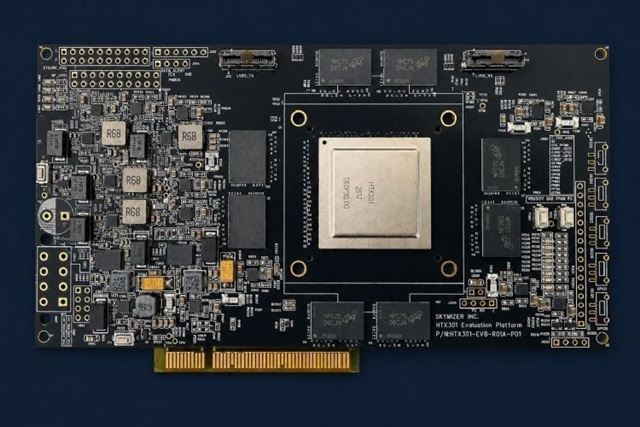
The generative artificial intelligence landscape continues to evolve rapidly, pushing companies to seek increasingly efficient solutions for Large Language Model (LLM) inference. In this context, Skymizer has announced the launch of the HTX301, a new hardware accelerator specifically designed to bring large-model inference directly on-premises. This move highlights a growing trend in the industry: the need to balance performance, data control, and operational costs.
The HTX301 positions itself as a direct answer to the challenges organizations face when running LLMs in local environments. The goal is to provide dedicated computing capacity that can handle the intensive VRAM and throughput requirements typical of LLM inference, without having to rely exclusively on external cloud infrastructures. For CTOs, DevOps leads, and infrastructure architects, solutions like the HTX301 represent a concrete option for consolidating their internal AI strategies.
The "Decode-First" Approach and Its Implications
One of the distinctive features of the HTX301 is its "decode-first" approach. In the context of LLM inference, this refers to a hardware architecture optimized for the decoding phase, which is crucial for the sequential generation of tokens. While the "prompt processing" (or "prefill") phase processes the initial input, the decoding phase generates one token at a time, making per-token latency a critical factor for user experience and overall efficiency.
Traditional accelerators often balance processing capabilities for training and inference, or for different inference phases. A "decode-first" design suggests a targeted optimization to reduce bottlenecks in output generation, potentially improving throughput for smaller batch sizes and reducing latency for real-time responses. This is particularly relevant for interactive applications where response speed is paramount.
Benefits and Considerations for Local Deployments
The emphasis on on-premise inference with the HTX301 addresses several strategic needs for businesses. First and foremost, data sovereignty: keeping data and models within one's own infrastructure boundaries ensures greater control over security, regulatory compliance (such as GDPR), and privacy. This is a decisive factor for highly regulated sectors like finance or healthcare.
Furthermore, self-hosted deployments can offer significant advantages in terms of long-term Total Cost of Ownership (TCO). Although the initial hardware investment (CapEx) may be higher than a cloud-based OpEx model, eliminating recurring costs for cloud resource usage and the ability to optimize hardware utilization can lead to substantial savings. For those evaluating on-premise deployments, AI-RADAR offers analytical frameworks on /llm-onpremise to assess the trade-offs between costs, performance, and control.
The Future of Enterprise AI Acceleration
The launch of solutions like Skymizer's HTX301 highlights a clear direction in the AI market: the growing demand for specialized hardware optimized for specific workloads. It's no longer just about having powerful GPUs, but about having silicon designed to maximize efficiency in specific scenarios, such as "decode-first" LLM inference.
For companies aiming to build and maintain robust and scalable AI infrastructures, choosing the right accelerator is crucial. This decision involves a careful evaluation of hardware specifications, VRAM requirements, desired throughput, and acceptable latency, all balanced with control, security, and TCO needs. The HTX301 fits into this context, offering a targeted option for those looking to bring the power of Large Language Models directly into their datacenter.


💬 Comments (0)
🔒 Log in or register to comment on articles.
No comments yet. Be the first to comment!