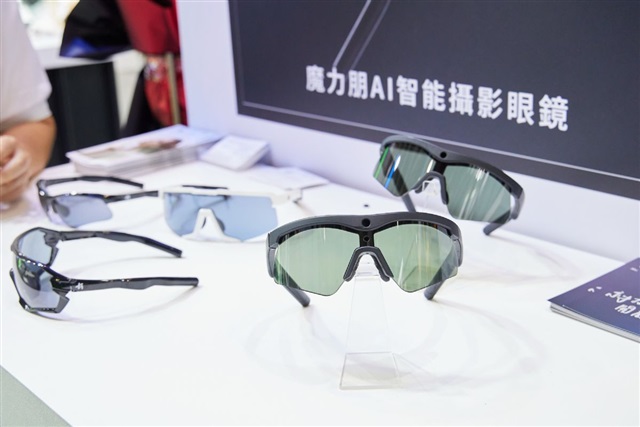
Smart Glasses: The Waveguide Battle Among Asian Suppliers
The smart glasses sector is experiencing a phase of rapid evolution, fueled by the promise of integrating augmented reality (AR) into daily and professional life. At the heart of this innovation lies an increasingly fierce competition among optical component suppliers, particularly concerning waveguides. Taiwan and China have emerged as key players in this technological “battle,” with their manufacturers vying for supremacy in the development and supply of these essential elements.
The race for smart glasses is not just a matter of design or software; it is rooted in the ability to produce sophisticated and miniaturized hardware. For companies evaluating the adoption of AR solutions for AI workloads at the edge, the availability and quality of these components are decisive factors for successful deployments.
The Crucial Role of Waveguides in AR
Waveguides are fundamental optical components for smart glasses, responsible for projecting digital images directly into the user's eye, superimposing them onto the real world. Their importance lies in their ability to offer a wide field of view, high brightness, and optimal transparency, all within a compact and lightweight form factor. The technical challenges in their production are significant: they require advanced materials, precision manufacturing processes, and complex engineering to minimize distortions and maximize light efficiency.
The quality of waveguides directly influences the user experience, determining factors such as perceived latency, visual fidelity, and comfort. For professional applications, where precision and reliability are paramount, the choice of waveguide supplier can have a significant impact on the device's overall performance and, consequently, on the effectiveness of on-device AI solutions for tasks like predictive maintenance or remote assistance.
Implications for the Ecosystem and Edge Deployment
The competition among Taiwanese and Chinese optical suppliers for waveguides has profound implications for the entire smart glasses ecosystem. A robust and diversified supply chain is essential to ensure production scalability and to mitigate risks associated with reliance on a single supplier. For companies planning to implement smart glasses solutions on a large scale, stability and innovation in this market segment are crucial.
Integrating AI functionalities directly into smart glasses requires edge processing capabilities, often with stringent requirements for power consumption and heat dissipation. Waveguides, by contributing to miniaturization and optical efficiency, allow more resources to be allocated to compact computing modules. This is particularly relevant for on-premise or air-gapped deployments, where data sovereignty and control over infrastructure are priorities. The evaluation of the Total Cost of Ownership (TCO) for such solutions must consider not only the cost of the devices but also the reliability and longevity of key components like waveguides.
Future Prospects and Technological Trade-offs
The “battle” over waveguides is set to intensify, driving further innovations in terms of materials, manufacturing processes, and optical design. The goal is to achieve a balance between visual performance, size, weight, and cost—a trade-off that manufacturers must constantly manage. The evolution of these components will be an enabling factor for the next generation of smart glasses, which promise to integrate increasingly advanced and contextually aware AI functionalities.
For CTOs and infrastructure architects, understanding the dynamics of this competition is fundamental for making informed decisions about future investments in AR technology. The choice of platforms and suppliers will need to consider not only immediate technical specifications but also the development roadmap of optical components, which will directly influence deployment capabilities and long-term innovation opportunities for edge AI applications.








💬 Comments (0)
🔒 Log in or register to comment on articles.
No comments yet. Be the first to comment!