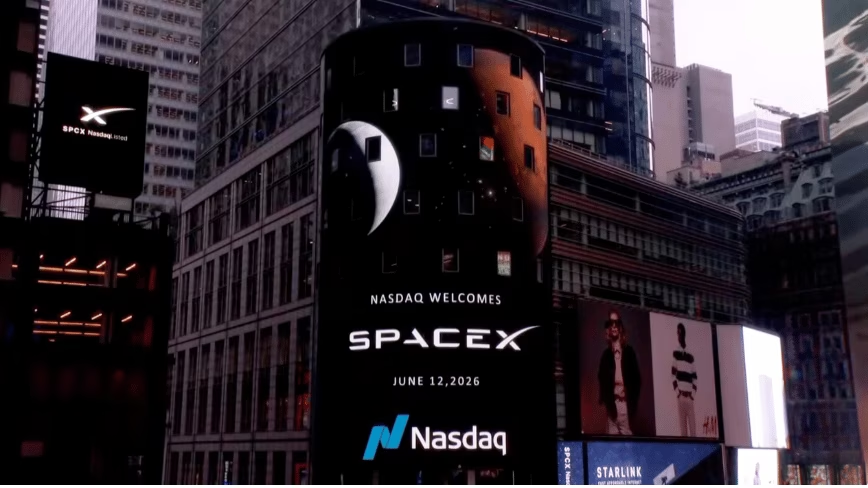
SpaceX's Nasdaq Debut: A Record-Breaking IPO
Last Friday, SpaceX marked a historic moment in the financial and technological landscape, officially entering the Nasdaq. The event was celebrated with the traditional opening bell ceremony, but what made this debut even more remarkable was its scale: it was the largest IPO (Initial Public Offering) ever recorded, a clear signal of the market's confidence in the aerospace company's ambitions and capabilities.
This step marks a new phase for SpaceX, transitioning from a private entity to a publicly traded company, opening new investment opportunities and potentially further accelerating its future projects. Investor attention is now focused on the company's ability to deliver on its promises of innovation and expansion in the increasingly strategic space sector.
An Orbital Launch to Celebrate the Stock Market Entry
In a gesture that perfectly embodies SpaceX's bold and unconventional spirit, the Nasdaq debut was preceded, just hours earlier, by an equally significant event: the launch of a Falcon 9 rocket. The vehicle successfully carried a new batch of Starlink satellites into orbit, reinforcing the constellation aimed at providing global internet connectivity.
This simultaneity between such a major financial event and a complex, high-risk technical operation did not go unnoticed. It highlighted SpaceX's dual nature: a company operating at the frontiers of aerospace engineering, yet also capable of navigating the complexities of global financial markets. The ability to manage these two vastly different spheres simultaneously is a distinctive trait that sets it apart from many other players in the industry.
Musk's Predictions and the Challenge of Innovation
SpaceX founder and CEO, Elon Musk, has previously expressed considerable skepticism regarding the company's chances of success, admitting he had given it “less than a 10% chance.” This statement, though from an earlier period, underscores the inherently risky and pioneering nature of the goals SpaceX has set for itself, from colonizing Mars to revolutionizing space travel.
The Nasdaq debut, with an IPO of such magnitude, therefore represents not only a financial milestone but also a validation of Musk's and his team's long-term vision. For investors, the challenge will be to balance the potential for exponential growth with the inherent risks of a sector that requires massive investments and long development times.
Implications for the Market and the Future of Space Exploration
SpaceX's entry into the stock market has significant implications not only for the company itself but for the entire aerospace sector and the global market. Its record valuation could act as a catalyst for other “New Space” companies, encouraging further investment and innovation.
For AI-RADAR, although the primary focus is on Large Language Models and on-premise infrastructures, the SpaceX event highlights the growing interconnectedness between high-tech sectors and financial markets. A company's ability to innovate and attract capital is fundamental for any technological development, including those related to AI. While not directly linked to on-premise LLM deployments, SpaceX's success reflects a broader trend of investment in frontier technologies that can indirectly influence the availability of resources and talent for other tech domains.






💬 Comments (0)
🔒 Log in or register to comment on articles.
No comments yet. Be the first to comment!