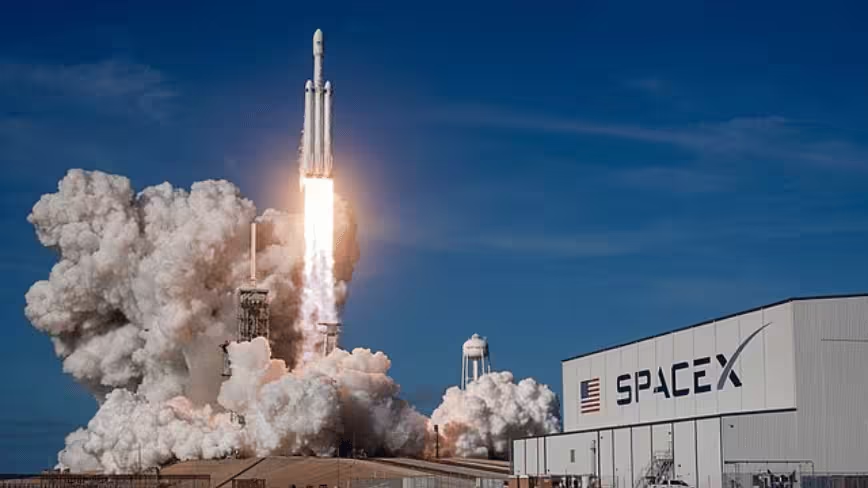
SpaceX's Colossal Investment in Starship
SpaceX has allocated over $15 billion to the development of its ambitious Starship megarocket. This figure, which emerged from the company's confidential pre-IPO prospectus and was reported by Reuters, quantifies for the first time the cumulative investment in the project. Elon Musk's company aims to revolutionize space access, making it significantly cheaper and more frequent.
The substantial capital expenditure underscores the engineering and logistical scale of Starship, a fully reusable launch system designed to transport massive payloads and, eventually, humans to the Moon and Mars. SpaceX's vision is to transform space launches from rare, costly events, typical of government programs, into routine operations with a cadence comparable to commercial airline flights.
The Vision of an Airline Cadence for Space
SpaceX's aspiration for an "airline-like cadence" for Starship launches represents a radical paradigm shift in the aerospace sector. Traditionally, rocket launches are complex, lengthy, and expensive processes, with high preparation times and costs limiting their frequency. Starship's full reusability is the cornerstone of this strategy, aiming to drastically reduce operational costs per launch.
Such an approach could unlock new economic and scientific opportunities, making space accessible to a wide range of actors. The ability to launch frequently and at low cost could accelerate the development of orbital infrastructures, from the next generation of satellite constellations to research and production platforms in low Earth orbit.
Implications for Infrastructure and Data
While the source does not directly focus on AI technologies, SpaceX's vision of low-cost, high-frequency space access carries significant implications for the future of digital infrastructures and, consequently, for AI workloads. A drastically reduced cost per launch could pave the way for new architectures for space-based data centers or for denser, more powerful satellite constellations capable of hosting advanced computing capabilities.
For CTOs, DevOps leads, and infrastructure architects evaluating deployment options, the evolution of space access could one day introduce unprecedented scenarios for data sovereignty, network resilience, and extreme edge computing. The possibility of deploying specialized hardware for LLM Inference or training in orbit, or on lunar platforms, while still futuristic, could redefine the TCO and operational constraints for certain applications. AI-RADAR monitors these trends, offering analytical frameworks on /llm-onpremise to evaluate the trade-offs between self-hosted and cloud solutions, an analysis that might extend to "space-hosted" scenarios in the not-too-distant future.
Future Prospects and Technological Challenges
The investment of over $15 billion in Starship highlights SpaceX's commitment to pursuing a bold vision that extends beyond the current boundaries of space exploration and utilization. Achieving an airline-like launch cadence will require not only further technological advancements but also the resolution of complex operational and regulatory challenges.
Starship's success could not only facilitate human expansion into space but also create an entirely new ecosystem for terrestrial and orbital infrastructure. For technology decision-makers, understanding these dynamics is crucial for anticipating future deployment scenarios and for assessing how innovations in the space sector might influence long-term strategies related to computing, data, and connectivity.









💬 Comments (0)
🔒 Log in or register to comment on articles.
No comments yet. Be the first to comment!