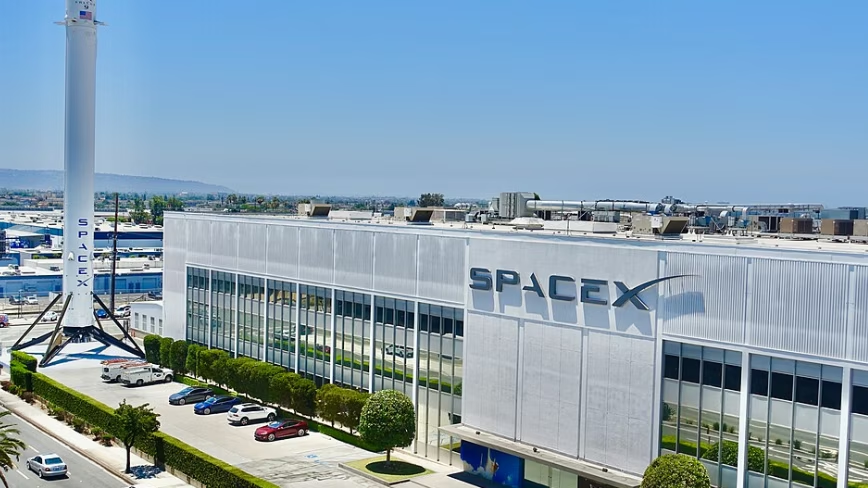
SpaceX reportedly showed investors a prototype AI device behind closed doors, only to have Elon Musk publicly dismiss the claim as ‘utterly false’. The Wall Street Journal broke the story, but Musk’s swift denial on X hasn’t quelled the speculation—because the purported device ties together his aerospace giant with his xAI artificial intelligence startup and a Qualcomm Snapdragon chipset.
What the prototype is said to be
According to WSJ’s reconstruction, the device looks like a handset, thinner than an iPhone, and runs on a proprietary operating system. Under the hood, it would leverage technology from xAI, Musk’s 2023 AI venture, and a Snapdragon processor from Qualcomm. The pitch reportedly took place during the funding round that paved the way for a record IPO valuation.
No technical sheet has leaked: the exact chip model, RAM, or compute capacity remains unknown. But recent Snapdragon SoCs pack neural processing units (NPUs) capable of running language models locally, provided they are optimized through quantization and model trimming. If Musk’s ecosystem is indeed working on a consumer AI device, the hardware foundation is already there.
The xAI connection
Integrating xAI technology is no minor detail. xAI built Grok, a large language model positioned as an alternative to ChatGPT, currently available to X (formerly Twitter) subscribers. Moving Grok—or a distilled, quantized version—onto a physical device would bypass cloud servers, cutting latency and strengthening data sovereignty. For those tracking deployment strategies, this shift from cloud to on-device inference is telling. It demands aggressive model compression, often via fine-tuning and quantization down to INT8 or even INT4, to stay within the memory and thermal limits of a pocketable gadget. Frameworks for on-device serving—llama.cpp, MediaPipe, and similar—are maturing fast, and SpaceX’s move could signal a push toward truly distributed AI.
Denial and broader context
Musk often denies reports that later prove accurate in altered forms. His track record with Tesla’s Robotaxi and Optimus robot shows that his hardware roadmap is rarely linear. SpaceX evaluating an AI device is not far-fetched: the company already has deep expertise in materials, batteries, and connectivity (Starlink), while xAI supplies the software stack. Whether the prototype ever existed or was merely a speculative exercise to gauge investor appetite remains the open question.
On-device AI implications
True or not, the report spotlights a trend: consumer hardware for generative AI. Devices like Rabbit R1 and Humane Ai Pin have shown demand for standalone AI assistants, but lukewarm reception due to functional gaps. A product with Musk-style vertical integration—Qualcomm silicon, proprietary OS, Grok LLM, Starlink connectivity—could reset expectations, provided execution matches ambition. For organizations weighing on-premise or edge deployment, it’s a signal that the race to bring language models outside the cloud is entering the industrial design phase, with ripple effects on hybrid pipelines and specialized hardware requirements. AI-RADAR tracks precisely these intersections of silicon, software, and deployment strategy.








💬 Comments (0)
🔒 Log in or register to comment on articles.
No comments yet. Be the first to comment!