A Strategic Financial Maneuver
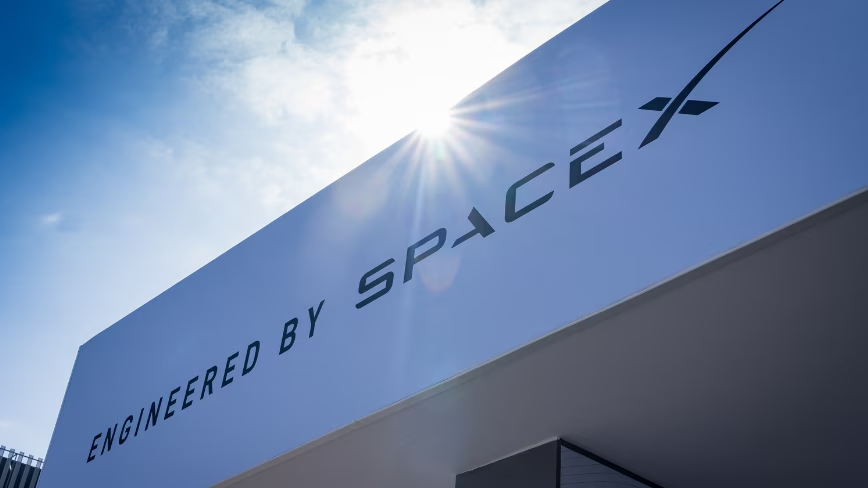
Regulatory documents filed in anticipation of SpaceX's potential IPO have revealed a significant financial operation. The company secured a $20 billion bridge loan from a consortium of major banks. This strategic move was undertaken to retire $17.5 billion of high-interest "junk debt" that had been accumulated by X (formerly Twitter) and xAI.
This operation underscores Elon Musk's vision of consolidating his various ventures into a single conglomerate, optimizing capital management across the different entities. The debt refinancing not only reduces the financial burden for the companies involved but also potentially frees up resources that can be reinvested in key areas of development and innovation.
The Role of xAI in the AI Context
Within this ecosystem, xAI emerges as a crucial player in the artificial intelligence landscape, focusing on the development of Large Language Models (LLM) and other advanced technologies. Companies operating in this sector require massive investments in research and development, the acquisition of top-tier talent, and, critically, cutting-edge hardware infrastructure.
The financial stability of the group, bolstered by operations such as debt refinancing, is fundamental to ensuring that divisions like xAI have the capacity to sustain the high costs associated with building and training complex AI models. This includes the purchase of high-performance GPUs with substantial VRAM, dedicated servers, and resilient storage systems, all essential elements for maintaining a competitive edge.
Implications for AI Infrastructure Investments
For CTOs, DevOps leads, and infrastructure architects, company-level financial decisions directly impact the choice of deployment models for AI workloads. On-premise or self-hosted solutions, while offering advantages in data sovereignty and control, often require significant initial capital expenditure (CapEx) for hardware acquisition, such as NVIDIA A100 or H100 GPUs, along with their VRAM and throughput requirements.
A solid financial foundation, like that resulting from a refinancing operation, can liberate the necessary capital for these strategic investments. This enables companies to pursue a more favorable Total Cost of Ownership (TCO) in the long term, avoiding the operational cost fluctuations typical of cloud services and ensuring tighter control over performance and security. The ability to invest in bare metal and dedicated infrastructure is a distinguishing factor for those aiming to optimize their AI pipelines.
Future Prospects and Strategic Control
The financial flexibility gained through refinancing operations allows companies to maintain greater strategic control over their technological direction. For entities like xAI, which handle sensitive data and proprietary models, the ability to operate in air-gapped or self-hosted environments is crucial for compliance, security, and the protection of intellectual property.
This financial agility supports decision-makers in choosing deployment models that prioritize control, data sovereignty, and operational cost optimization—central aspects for those evaluating alternatives to the cloud. AI-RADAR, for instance, offers analytical frameworks to assess the trade-offs of on-premise deployments, highlighting how financial robustness is a cornerstone for realizing such strategies.







💬 Comments (0)
🔒 Log in or register to comment on articles.
No comments yet. Be the first to comment!