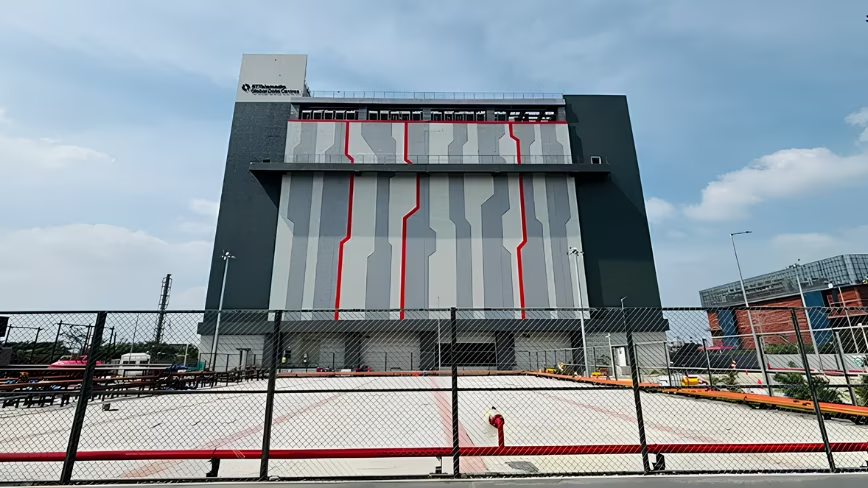
STT Global Data Centres India Towards IPO in Mumbai
STT Global Data Centres India, a data center operator with a ownership structure that sees control by Singaporean entities and a minority stake held by the Tata group, is planning an Initial Public Offering (IPO) on the Mumbai stock exchange. The operation, which Bloomberg reported last Friday, citing sources close to the matter, could aim to raise up to $500 million, representing a significant step for the digital infrastructure sector in India.
The company has already invited several banks to submit their proposals for managing the IPO this month. This strategic positioning would allow STT Global Data Centres India to precede other industry players such as Sify and Yotta, entering the first wave of IPOs exclusively focused on data centers in the Indian subcontinent. Such a move highlights the rapid expansion and growing maturity of the local infrastructure market.
The Strategic Role of Data Centers for On-Premise AI
The expansion and capitalization of data center operators like STT Global Data Centres India are of crucial importance for the global technological landscape, particularly for companies evaluating on-premise deployments of Large Language Models (LLM) and other artificial intelligence workloads. Data centers constitute the physical backbone upon which self-hosted infrastructures are built, providing the controlled and secure environment necessary to host high-performance hardware.
For CTOs, DevOps leads, and infrastructure architects, the availability of modern and well-equipped data centers is fundamental. These facilities must ensure not only space and power but also low-latency connectivity, efficient cooling systems, and the ability to support high-density GPU servers, essential for LLM inference and training. The choice of robust infrastructure is directly related to the ability to manage stringent VRAM, throughput, and scalability requirements, key elements for optimizing AI model performance.
Implications for the Market and Tech Decision-Makers
The influx of new capital into the data center sector, such as that expected from STT Global Data Centres India's IPO, can have a direct impact on the Total Cost of Ownership (TCO) for companies investing in on-premise AI solutions. Greater availability of competitive infrastructure can lead to more favorable costs for hosting, power, and connectivity, reducing entry barriers for organizations wishing to maintain control over their data and models.
In a context where data sovereignty and regulatory compliance (such as GDPR) are increasingly prioritized, the ability to choose local and air-gapped data centers becomes a differentiating factor. The expansion of the data center market in key regions like India offers tech decision-makers more options to implement deployment strategies that balance performance, security, and compliance, without having to rely exclusively on public cloud solutions. For those evaluating on-premise deployments, AI-RADAR offers analytical frameworks on /llm-onpremise to assess the trade-offs between different infrastructure options.
Future Prospects of the Data Center Sector
STT Global Data Centres India's initiative reflects a global trend of strong growth in the data center sector, largely fueled by the demand for computational capacity for artificial intelligence. As companies continue to develop and deploy increasingly complex LLMs, the need for resilient and scalable physical infrastructures will only increase. This scenario creates significant opportunities for data center operators and, at the same time, offers enterprise customers a wider range of choices for their AI workloads.
Competition among data center providers, stimulated by events such as IPOs, can lead to innovations and improvements in the services offered, directly benefiting companies seeking efficient solutions for their local AI stacks. India, with its growing digital economy, is positioned as a key market for this evolution, solidifying the role of data centers as fundamental pillars of modern technological infrastructure.






💬 Comments (0)
🔒 Log in or register to comment on articles.
No comments yet. Be the first to comment!