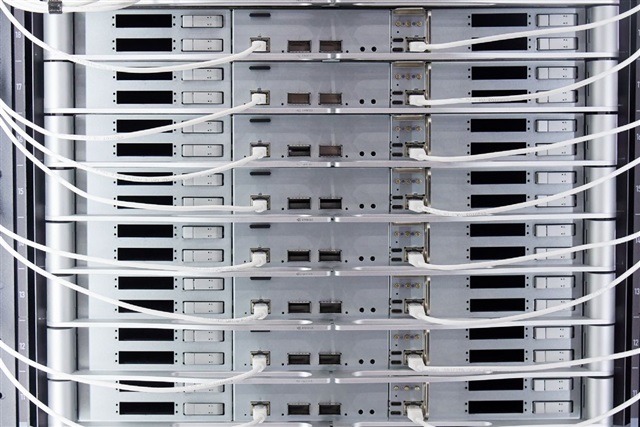
In the hardware world for artificial intelligence, attention is often monopolized by GPUs, VRAM, and quantization techniques. Less visible, but just as critical to the performance of an on-premise cluster, is the physical layer of optical interconnection. It is here that indium phosphide (InP) substrates are emerging as a strategic asset, as the supply chain for optical engines undergoes a profound reshuffle.
Optical engines are the heart of transceiver modules that connect servers and GPU nodes within data centers. With the adoption of 800G links and the approach of 1.6T, traditional materials like silicon are hitting physical limits in high-frequency modulation. InP, by contrast, enables lasers and electro-absorption modulators with superior energy efficiency and wider bandwidth—essential to sustain the east-west traffic generated by distributed training of large language models. In an on-premise context, where every watt matters and node-to-node latency can become the bottleneck, the availability of these components is far from a detail: it directly affects total cost of ownership and project scalability.
The news that InP substrates are becoming a strategic asset signals a shift in the balance of power along the supply chain. Historically, production of InP wafers has been concentrated in a few foundries, with low volumes and high costs. The AI boom has suddenly multiplied demand, attracting new players and forcing suppliers to revise contracts and priorities. This reshuffle can have at least two second-order effects. First, potential vertical integration by large hyperscalers, which could lock in supplies for their own cloud data centers, leaving on-premise operators with residual volumes at less competitive prices. Second, an incentive to diversify technologies, accelerating the development of alternatives such as silicon photonics or semiconductor optical amplifiers, which could reduce the dependency on InP and, in the medium term, rebalance the market.
The immediate losers are those organizations planning a large on-premise deployment without having mapped the procurement risk for optical components. In a training project requiring hundreds of interconnected nodes, the unavailability or delayed delivery of transceivers can stall the entire investment, eroding the competitive advantage of direct infrastructure control. The winners, on the other hand, are networking equipment vendors that already integrate optical engine manufacturing or hold long-term agreements with InP foundries. Their negotiating power grows, along with their ability to dictate roadmaps and pricing.
These dynamics are not just for networking specialists. The entire on-premise AI ecosystem—from system integrators to orchestration software developers—should start tracking optical engine availability with the same attention reserved for GPUs. Data sovereignty and operational control, pillars of the self-hosted model, are built on hardware layers that today appear peripheral but tomorrow could become the chokepoint of the supply chain.








💬 Comments (0)
🔒 Log in or register to comment on articles.
No comments yet. Be the first to comment!