
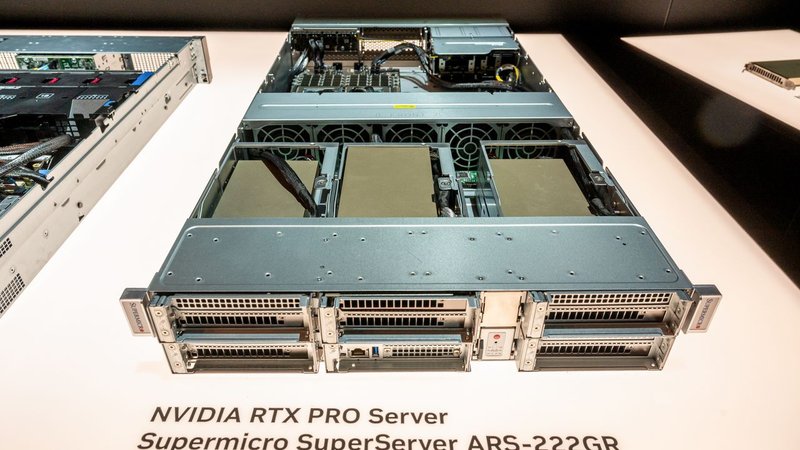
In late June, the Keelung District Court ordered the detention of two Super Micro managers, identified by local press as Wang and Lin. The accusation revolves around the alleged illegal routing of servers equipped with Nvidia chips to China, circumventing export controls that have been shaping the AI hardware market for years.
The case, which came to light between June 30 and July 1, signals a tightening by Taiwanese authorities on a sensitive front: the final destination of machines designed for AI workloads. If confirmed, the violation would imply not only legal penalties for the individual managers but also repercussions for Super Micro's supply chain, a key player in assembling high-density GPU servers.
It is worth recalling that US restrictions have progressively barred Chinese entities from accessing advanced chips such as the Nvidia A100 and H100 series, forcing manufacturers to redesign their product lines to comply with imposed performance thresholds. In this context, system integrators must navigate a dual constraint: on one hand, the demand for computing power for Large Language Model training and inference; on the other, the need to rigorously verify the end-use of equipment. A single weak link can trigger investigations, customs stops, and delivery delays that derail infrastructure planning.
For IT managers evaluating on-premise deployments, the Super Micro incident highlights the fragility of assumptions about continuous hardware availability. Those designing local LLM clusters often work from a premise of supply chain stability; but when a strategic supplier comes under investigation, the entire project's operations can be jeopardized. This goes beyond formal compliance: transparency about the physical component becomes integral to data sovereignty, as hardware from opaque or unverified channels may carry security vulnerabilities or risk of interdiction.
The industry response so far has unfolded on multiple levels: from strengthening due diligence processes to adopting multiple suppliers, and even evaluating alternative solutions such as less performant chips exempt from restrictions. However, every choice affects TCO and inference performance, forcing organizations to deeply examine the trade-offs. Those closely following the on-premise hosting debate know that hardware selection is just one piece of a larger puzzle, involving operational costs, procurement windows, and political-commercial risks. For those evaluating such infrastructure, AI-RADAR offers analytical frameworks at /llm-onpremise to weigh these aspects, without any claim to recommend a single solution.
The Taiwanese investigation is not a bolt from the blue: it fits into a climate of growing institutional attention to the physical flows of critical technology. And as the judiciary continues its work, this episode rightly joins the list of signals that should guide AI architecture decisions, reminding us that choosing a server is never just about technical specifications.








💬 Comments (0)
🔒 Log in or register to comment on articles.
No comments yet. Be the first to comment!