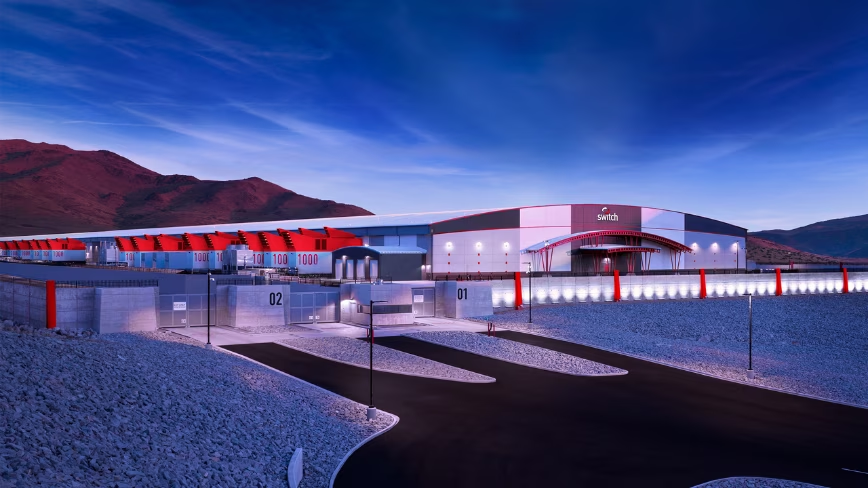
Switch and the Exponential Growth of Data Centers
Switch, a Las Vegas-based company specializing in data center development, is currently engaged in discussions for a significant funding round. The aim is to raise billions of dollars, targeting a valuation of at least $50 billion. This figure, as reported by The Information, highlights a radical transformation in the perceived value of digital infrastructure.
Just a few years ago, such a valuation for a data center developer would have been considered almost implausible. Today, however, it reflects a market trend where the demand for computational and storage capacity is constantly increasing, driven in particular by the explosion of workloads related to artificial intelligence and Large Language Models (LLM).
The Demand for Infrastructure in the AI Era
The current artificial intelligence boom is generating an unprecedented demand for robust and scalable infrastructure. Data centers are the beating heart of this revolution, providing the necessary environment for training and Inference of complex models. Whether for cloud deployments or self-hosted solutions, the need for secure physical spaces, high-speed connectivity, reliable power, and advanced cooling systems has become critical.
Companies operating in the data center sector, such as Switch, are therefore in a strategic position to capitalize on this demand. The ability to offer cutting-edge infrastructure, capable of supporting the specific needs of AI workloads – such as high GPU density and VRAM requirements – is a key factor for success and market valuations.
Implications for On-Premise Deployment Strategies
For CTOs, DevOps leads, and infrastructure architects, the choice between cloud and on-premise deployment for AI/LLM workloads is increasingly complex. The growth of companies like Switch underscores the importance of having access to high-quality physical infrastructure, whether opting for building one's own data center or choosing colocation.
On-premise deployment decisions are often driven by considerations such as data sovereignty, regulatory compliance, the need for air-gapped environments, and tighter control over the long-term Total Cost of Ownership (TCO). While the cloud offers flexibility, self-hosted or hybrid solutions can provide greater customization and optimization for specific workloads, especially when managing large data volumes or proprietary models. For those evaluating on-premise deployments, AI-RADAR offers analytical frameworks at /llm-onpremise to understand the trade-offs between control, costs, and scalability.
Future Prospects in the Digital Infrastructure Market
Switch's potential valuation of over $50 billion is not just an indicator of a single company's success but a clear signal of investor confidence in the digital infrastructure sector. This trend suggests that value lies not only in the development of software or AI models but also in the physical foundations that make them possible.
As AI continues to evolve and integrate into every aspect of the economy, the demand for cutting-edge data centers is set to grow further. Companies that can offer resilient, efficient, and secure infrastructure solutions will be those that drive the next chapter of technological innovation, supporting both cloud giants and enterprises choosing more controlled and localized deployment paths.










💬 Comments (0)
🔒 Log in or register to comment on articles.
No comments yet. Be the first to comment!