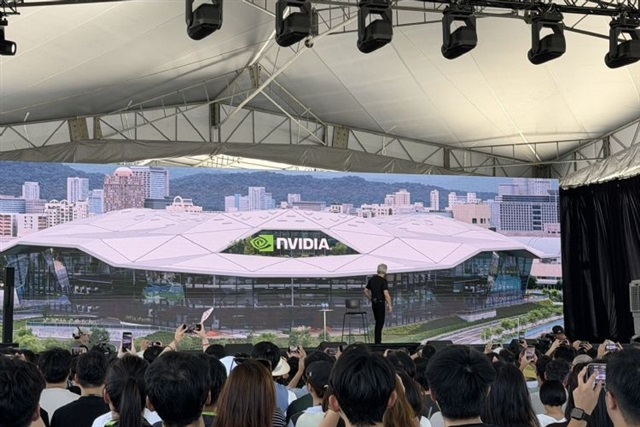
Jensen Huang's Statement and Taiwan's Role
Jensen Huang, CEO of NVIDIA, recently highlighted Taiwan's crucial role, defining it as the epicenter of the artificial intelligence revolution. This statement underscores the island's strategic position in the global technological landscape, a recognition that comes as no surprise to industry insiders given its consolidated leadership in advanced semiconductor manufacturing.
Huang's assertion is not merely an observation; it also emphasizes the importance of a robust and innovative ecosystem. Taiwan has long been a fundamental pillar of the global supply chain, providing essential components that fuel innovation in key sectors, from consumer electronics to data centers, and now more than ever for AI.
Massive Investment for Innovation
Supporting this vision, Huang mentioned a significant investment: US$150 billion in Capital Expenditure (CapEx) aimed at bolstering the local ecosystem. While the source does not specify the details of this spending, an investment of this magnitude suggests a considerable expansion of production capabilities, research and development, and technological infrastructure.
This capital inflow is vital to sustain the growing demand for high-performance hardware, which is indispensable for the training and Inference of Large Language Models (LLM) and other AI applications. For companies evaluating self-hosted deployments, the availability of advanced silicon and a reliable supply chain is a critical factor in ensuring the scalability and efficiency of their AI infrastructures.
Taiwan's Centrality in the AI Supply Chain
Taiwan's position as the "center of the AI revolution" is intrinsically linked to its supremacy in chip production. Taiwanese companies are at the forefront of manufacturing GPUs and other AI accelerators, which are fundamental components for any AI computing architecture, whether cloud-based or on-premise.
Taiwan's ability to produce these critical components directly influences the global availability and cost of hardware. For CTOs and infrastructure architects, understanding the dynamics of this supply chain is essential for planning AI infrastructure investments, managing procurement risks, and optimizing the Total Cost of Ownership (TCO) of their systems.
Implications for On-Premise Deployments
For organizations prioritizing control, data sovereignty, and security through on-premise or air-gapped deployments, the stability and production capacity of the Taiwanese ecosystem are of paramount importance. The availability of cutting-edge silicon is a prerequisite for building high-performance and resilient local AI stacks.
The ability to access state-of-the-art hardware, with specifications such as high VRAM and Throughput, is crucial for running complex LLMs locally. AI-RADAR offers analytical frameworks on /llm-onpremise to evaluate the trade-offs between different hardware architectures and deployment strategies, helping companies make informed decisions in a rapidly evolving technological landscape.






💬 Comments (0)
🔒 Log in or register to comment on articles.
No comments yet. Be the first to comment!