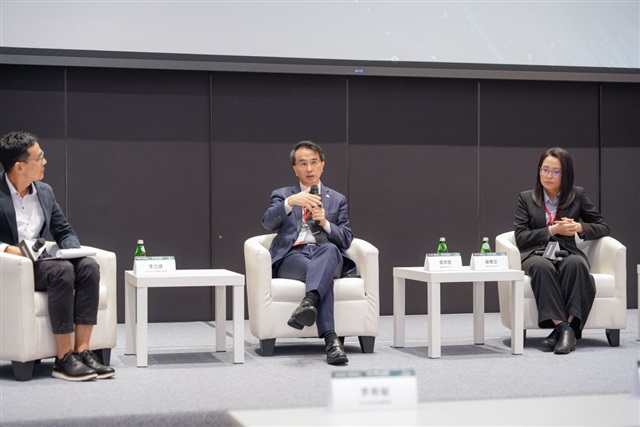
A New Strategic Imperative for Taiwan at Tech Forum 2026
The Tech Forum 2026 is set to be a pivotal moment for redefining Taiwan's technological strategy. The call to "design space, not just build it" signals a clear ambition: to evolve from a predominant role in hardware component production and assembly to a primary actor in the conception and development of innovative solutions. This strategic vision is fundamental for an economy that has historically excelled in semiconductor manufacturing, a vital sector for the entire global tech industry.
This transition implies greater investment in research and development, intellectual property, and the creation of comprehensive technological ecosystems. For Taiwan, this means not only maintaining leadership in advanced silicon production but also extending its influence to the design, architecture, and integration phases of complex systems. Such an evolution is crucial for addressing the challenges of technological sovereignty and ensuring a prominent position in emerging sectors like artificial intelligence and high-performance computing.
Taiwan's Role in the Global Semiconductor Ecosystem
For decades, Taiwan has been an irreplaceable pillar of the global technology supply chain, particularly concerning semiconductors. Taiwanese companies are responsible for producing a significant share of the most advanced chips, essential for every device, from servers to mobile devices, and crucial for accelerating artificial intelligence workloads. The ability to "build" has been its strength, but the global landscape is rapidly changing.
This push towards "designing space" reflects Taiwan's need to diversify and strengthen its position. It's not just about manufacturing GPUs or CPUs, but actively contributing to their architecture, the software frameworks that enable them, and the development pipelines that maximize their performance. This integrated approach is vital for maintaining a competitive edge and influencing the future directions of technological innovation, especially in an era dominated by Large Language Models (LLM) and the growing demand for computing power.
Implications for AI and On-Premise Deployments
For companies evaluating on-premise LLM deployments, Taiwan's strategy has direct implications. Greater involvement from Taiwan in the design phase could lead to increased innovation and availability of hardware optimized for specific AI computing needs. This includes the development of silicon with higher VRAM, greater throughput, and more efficient architectures for large-scale LLM inference and fine-tuning.
Access to cutting-edge hardware is a decisive factor for the TCO of on-premise deployments. A Taiwanese ecosystem more oriented towards design could foster the creation of more competitive and customized solutions, reducing dependence on a few suppliers and offering greater flexibility. For those seeking data sovereignty and air-gapped environments, having a wide choice of performant and controllable hardware is essential. AI-RADAR, for example, offers analytical frameworks on /llm-onpremise to evaluate the trade-offs between self-hosted and cloud solutions, highlighting how hardware availability is a primary constraint.
Future Prospects: Innovation and Strategic Autonomy
Taiwan's strategic transition, from the role of "builder" to that of "designer of space," is not without its challenges. It requires massive investments in human capital, research and development infrastructure, and close collaboration among industry, academia, and government. However, the opportunities are immense. Positioning itself as a leader in designing complex solutions, from chips to complete systems, can consolidate its global influence.
This strategic shift would not only strengthen the resilience of the global supply chain but also promote greater technological autonomy for Taiwan. In a world where geopolitical competition increasingly intertwines with technological innovation, the ability to control the entire product lifecycle, from conception to production, becomes an invaluable asset. For the AI sector, this means potential access to faster and more diversified hardware innovation, fundamental for the evolution of Large Language Models and their enterprise applications.







💬 Comments (0)
🔒 Log in or register to comment on articles.
No comments yet. Be the first to comment!