
Tapaya: €1 Million to Innovate In-Person Payments
Tapaya, a Prague-based startup, has announced the completion of a €1 million pre-seed funding round. The operation was led by Passion Capital, with co-lead participation from Depo Ventures and a follow-on investment from BADideas.fund. This capital is earmarked to support the company's mission: to revolutionize how in-person payments are accepted, making them more accessible and less burdensome for businesses.
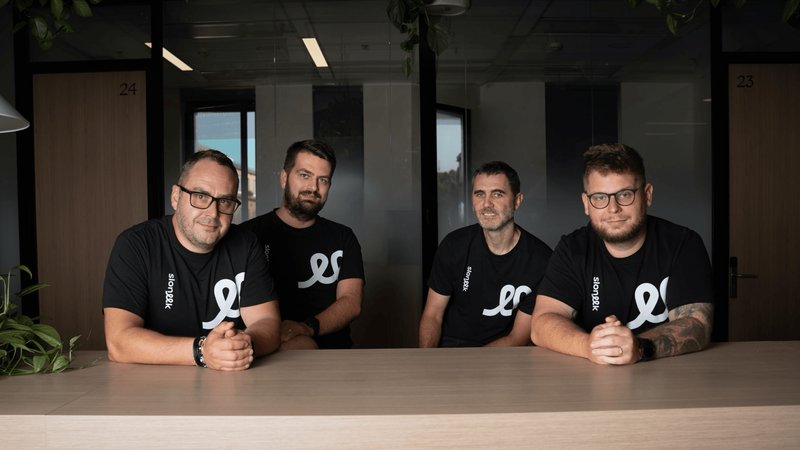
Founded in 2025 by Laura Ďorďová, Roman Kuchařík, and Petr Zahradník, Tapaya focuses on developing an innovative software infrastructure. This technology allows banks, fintech companies, and software platforms to directly integrate physical payment acceptance within their existing applications. The company has already initiated integrations in the Czech Republic and is expanding its partnerships across Central and Eastern Europe, as well as the Baltics.
The Complexity of Traditional Payments and Tapaya's Vision
The in-person payment sector still heavily relies on dedicated hardware terminals. This dependency generates significant costs and operational complexity for merchants and software providers. Integrating payment functionalities into existing platforms, such as POS systems, ERP software, or kiosks, represents a lengthy and resource-intensive process. The primary reasons for this complexity lie in stringent certification requirements and fragmented underlying infrastructure.
Laura Ďorďová, co-founder and CEO of Tapaya, emphasized the need for change: "We want accepting payments to be as simple as turning on a light. For decades, it has meant relying on a piece of hardware, buying it, carrying it, connecting it, and reconciling it separately. Merchants are tired of that complexity." Tapaya's vision is to overcome these barriers by offering a solution that radically simplifies the entire process.
A Software Platform for Compliance and Integration
Tapaya addresses these challenges by consolidating compliance, certification, and payment processor integrations into a single software layer. Its platform allows developers to enable payment acceptance across a wide range of commercial devices, including those based on Android and iOS, effectively turning standard hardware into payment terminals. This approach eliminates the need for dedicated devices, reducing costs and operational complexity for merchants.
By simplifying integration and reducing reliance on third parties, the company aims to shorten implementation timelines from months to just days. The system is designed to be fully compliant with evolving standards set by the PCI Security Standards Council, including the PCI MPoC (Mobile Point of Acceptance) framework, which enables secure card acceptance on commercial devices. Abstracting these requirements into a single integration allows Tapaya's partners to offer in-person payments without building their own certification infrastructure.
Future Prospects and Impact on Infrastructural Control
The funds raised will be used to complete Tapaya's PCI MPoC certification and for the further development of its in-house technology. Concurrently, the company intends to support the expansion of its partner network across Europe. This strategic investment not only strengthens Tapaya's position in the payment market but also highlights a broader trend towards solutions that offer greater control and flexibility over technological infrastructure.
For companies evaluating self-hosted alternatives or seeking to optimize the TCO of their operations, the ability to transform existing hardware into critical functionalities, such as payment acceptance, represents a significant advantage. This approach reduces dependence on proprietary solutions and specialized hardware, offering a more agile and potentially more economical model. While not directly related to LLMs, Tapaya's philosophy of consolidating complexity into a software layer to enable functionalities on generic hardware resonates with the principles of control and resource optimization that AI-RADAR explores for on-premise deployments.








💬 Comments (0)
🔒 Log in or register to comment on articles.
No comments yet. Be the first to comment!