Texas Transparency Reveals Tesla and Waymo Robotaxi Fleet Gap
New legislation in the state of Texas has recently mandated greater transparency for commercial autonomous vehicle operations, leading to the publication of significant data regarding robotaxi fleets. As of May 28, with the new regulations taking effect, information on authorizations for driverless ride-hailing services has become public record. This data offers a clear and quantifiable insight into the presence of two major players in the autonomous driving sector: Tesla and Waymo.
Texas's move aims to strengthen state oversight of companies operating autonomous vehicles, ensuring greater safety and accountability. For companies in the sector, this means a new level of scrutiny and the need to comply with more stringent operational standards, which can influence deployment strategies and fleet expansion.
Official Numbers: 42 Versus 577 Autonomous Vehicles
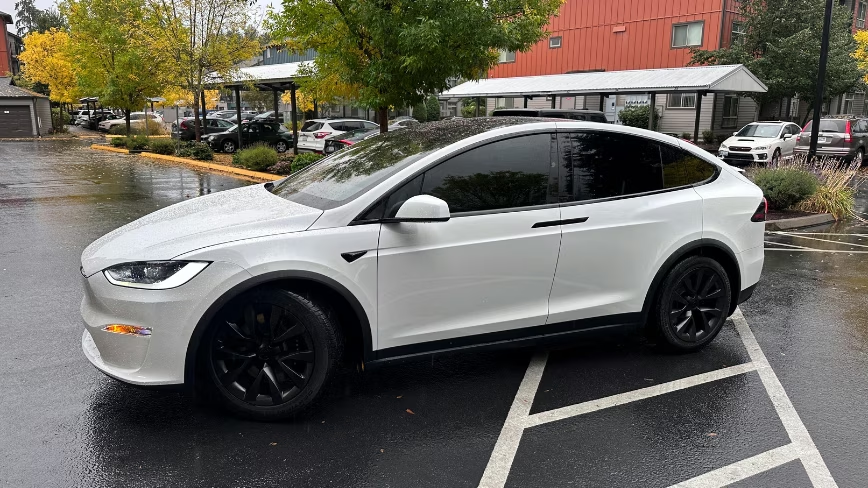
The data made public by Texas reveals a notable disparity in the size of authorized robotaxi fleets. Waymo, Alphabet's autonomous driving division, has obtained authorization to operate 577 autonomous vehicles in its driverless ride-hailing service. In the same context, Tesla, led by Elon Musk, is authorized with a fleet of 42 vehicles.
This disparity is evident: Tesla's fleet in Texas represents less than one-tenth the size of Waymo's. Such figures not only outline the current state of deployment for both companies in the specific Texas market but also raise questions about the different development and scalability strategies adopted by the two tech giants in the field of autonomous mobility. The transparency imposed by the law provides a public benchmark for evaluating the operational maturity and expansion capability of various operators.
Implications for Autonomous System Deployment
Managing and expanding large-scale autonomous vehicle fleets, such as Waymo's, requires an extremely robust and complex technological infrastructure. Each autonomous vehicle is an edge computing system in itself, generating and processing terabytes of data daily. This data is crucial for training artificial intelligence models, fine-tuning perception and decision algorithms, and validating operational safety.
For companies operating in this space, AI infrastructure deployment decisions are fundamental. The choice between cloud and on-premise solutions for data processing and the training of Large Language Models (LLM) or other AI-specific models for autonomous driving is driven by factors such as data sovereignty, compliance requirements, latency, and Total Cost of Ownership (TCO). An on-premise or hybrid deployment can offer greater control over sensitive data and lower latency for critical inference, but it involves significant investments in hardware, such as high-VRAM GPUs and high-performance storage systems.
Future Prospects and Regulatory Challenges
The publication of this data in Texas underscores a growing trend towards increased regulation and transparency in the autonomous vehicle sector. As the technology matures and spreads, regulatory authorities will increasingly demand details on operations, safety, and the scale of deployments. This evolving regulatory landscape adds another layer of complexity for companies seeking to scale their robotaxi operations.
For CTOs and infrastructure architects, the challenge is not just technological but also strategic. They must balance rapid innovation with the need to build scalable, secure, and compliant infrastructures with local and international regulations. The ability to effectively manage enormous data volumes, perform real-time inference, and constantly update AI models, all while maintaining a sustainable TCO, will be critical for long-term success in this rapidly evolving sector. AI-RADAR continues to monitor how these dynamics influence on-premise and hybrid deployment choices for AI workloads.









💬 Comments (0)
🔒 Log in or register to comment on articles.
No comments yet. Be the first to comment!