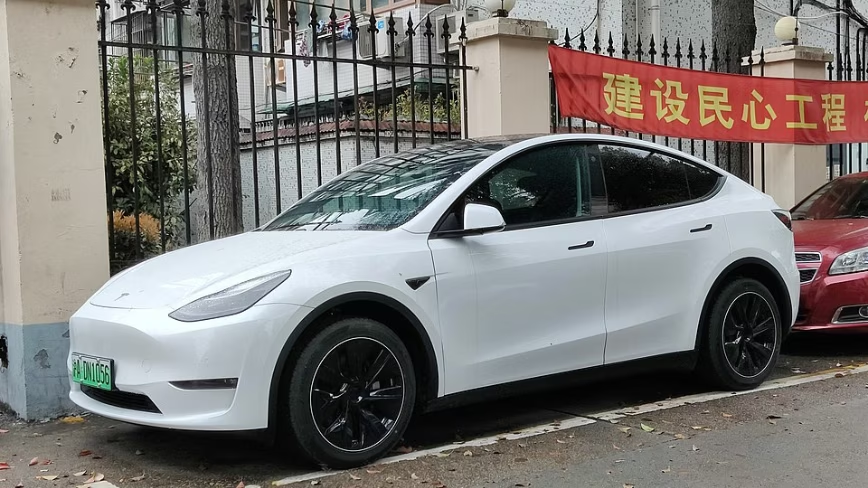
Tesla Enters the Chinese Market with FSD (Supervised)
Tesla has announced the availability of its Full Self-Driving (Supervised) system in China, including the country among the ten global markets where the technology is now accessible. The announcement, disseminated via the X platform, provided few specific details but represents Tesla's first official confirmation regarding FSD's presence in the world's largest electric vehicle market. This move comes after years of significant anticipation and delays.
The "Supervised" designation emphasizes that the system still requires active driver supervision, in line with current regulations and safety expectations for autonomous driving technologies. Tesla's entry into this segment of the Chinese market is particularly relevant, considering that its main local competitors have already offered autonomous driving solutions for several years, consolidating their position and gathering an extensive base of data and feedback.
Technical Implications and Deployment Challenges for Advanced AI Systems
The development and deployment of autonomous driving systems like FSD involve immense technical challenges, especially concerning the artificial intelligence infrastructure. These systems require enormous computing capabilities for both the training phase, which takes place in data centers with high-performance GPU clusters and high VRAM, and the inference phase, which must occur in real-time aboard the vehicle. Managing terabytes of video and sensor data, processing it, and executing complex models demand extremely optimized data and machine learning pipelines.
For companies operating in this sector, decisions regarding AI infrastructure deployment are crucial. The choice between self-hosted, cloud, or hybrid solutions depends on factors such as the latency required for real-time processing, data throughput, TCO, and the need to optimize models (e.g., through quantization) for inference on edge hardware with limited resources. The ability to continuously update and improve these systems requires a robust development and continuous deployment pipeline.
Competitive Landscape and Data Sovereignty in China
Tesla's delayed entry into the Chinese autonomous driving market places it in a mature competitive landscape. Local companies have had years to refine their algorithms, collect specific data on complex Chinese road and traffic conditions, and build consumer trust. This delay could pose a significant challenge for Tesla in gaining market share and demonstrating the superiority of its system.
A critical aspect in China is the issue of data sovereignty. Local regulations impose stringent requirements on the localization, processing, and storage of data collected within the country. For a system that constantly collects sensitive driving data, this means Tesla will likely need to adopt deployment solutions that ensure data residency within Chinese borders, often through local data centers or self-hosted infrastructures. This regulatory constraint is a decisive factor for the deployment strategies of any technology company operating in China, with direct implications for compliance and data control.
Future Prospects for AI in the Automotive Sector
The launch of FSD in China highlights the growing centrality of artificial intelligence in the global automotive sector. Competition among electric vehicle manufacturers is increasingly shifting towards software capabilities and AI-based driver assistance systems. This dynamic stimulates innovation not only in algorithms and models but also in dedicated hardware and deployment strategies.
For organizations developing and deploying complex AI solutions, evaluating the trade-offs between cloud and on-premise deployment, or a hybrid approach, remains a fundamental strategic element. Factors such as TCO, data security, low-latency requirements, and data sovereignty are essential drivers for these infrastructural decisions. For those evaluating on-premise deployment for AI/LLM workloads, AI-RADAR offers analytical frameworks and insights on /llm-onpremise to support the assessment of these complex trade-offs.






💬 Comments (0)
🔒 Log in or register to comment on articles.
No comments yet. Be the first to comment!