Tesla Sued Over Alleged Tumbler Lid Design Patent Infringement
A Design Dispute Between MiiR and Tesla
The technology landscape is often a stage for legal disputes, not only concerning complex software and algorithms but also seemingly simpler aspects like product design. This is the case with the recent legal action initiated by MiiR, a Seattle-based drinkware company, against the automotive and technology giant Tesla. The lawsuit, filed on May 28 in the US District Court in Seattle, accuses Tesla of copying distinctive design elements of a thermal tumbler.
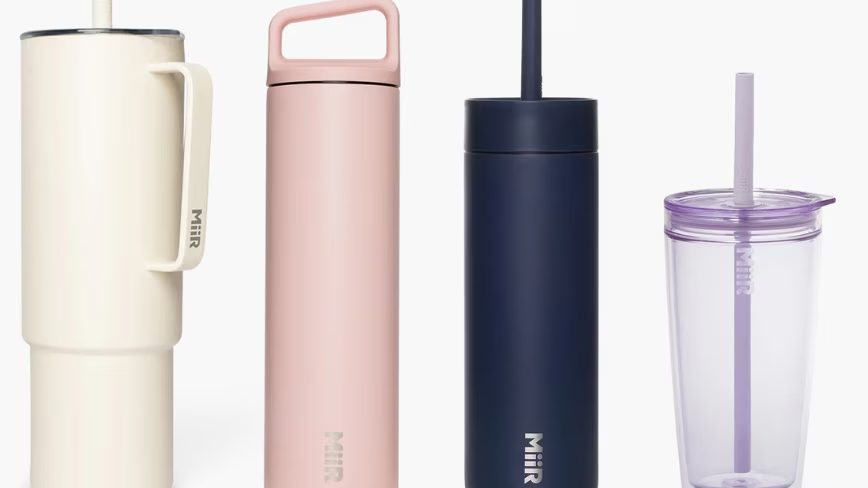
MiiR claims that Tesla's "On The Road Tumbler" infringes a registered design patent covering the lid of its own tumbler. The accusation also extends to the overall look of the Tesla product, which MiiR alleges mimics the cylindrical shape, rounded base, and other vertical details characteristic of its stainless steel tumbler.
Details of the Infringement Allegation
At the heart of the dispute is the alleged infringement of a design patent. Design patents protect the ornamental or aesthetic appearance of a useful article, rather than its functionality. In this specific case, MiiR has registered a patent that safeguards the aesthetics of its thermal tumbler's lid. The lawsuit aims to demonstrate that Tesla, with its product, deliberately replicated these protected features.
The accusations are not limited to the lid alone. MiiR highlights how Tesla's tumbler also adopts the overall shape of its product, including the cylindrical silhouette, the base with a specific curvature, and vertical details that contribute to the visual identity of the MiiR tumbler. This type of litigation underscores the importance of intellectual property even in sectors not strictly related to high technology, but which nonetheless benefit from innovation and distinctive design.
Implications for Intellectual Property in the Tech Sector
Although this specific lawsuit concerns a consumer product, the principle of intellectual property protection is fundamental for every technology company, including players operating in the field of LLMs and AI infrastructure. The ability to innovate and protect one's creations, be they algorithms, hardware architectures, or interface designs, is crucial for maintaining a competitive advantage and encouraging further investment in research and development.
Companies developing on-premise AI solutions, for example, invest significant resources in creating optimized software stacks, proprietary models, or specific hardware configurations. Protecting these assets through patents, copyrights, or trade secrets is essential to safeguard the TCO and strategic value of their innovations. An effective intellectual property protection strategy can prevent imitation and ensure that innovation efforts translate into long-term benefits.
Future Prospects and the AI-RADAR Context
The outcome of lawsuits like the one between MiiR and Tesla can have repercussions on how companies approach design and innovation, pushing them towards greater caution or more robust investments in prior art searches and patent registration. For the AI-RADAR audience, comprising CTOs, DevOps leads, and infrastructure architects, this case, while not directly related to AI, serves as a reminder of the importance of sovereignty and control, not only over data and infrastructure but also over one's innovations and intellectual property.
Protecting digital and physical assets is a cornerstone for anyone evaluating on-premise deployments, where total control over the environment also includes safeguarding unique solutions. AI-RADAR continues to explore the trade-offs and constraints related to these strategic decisions, offering in-depth analyses on /llm-onpremise to support companies in evaluating self-hosted alternatives versus the cloud for AI/LLM workloads.









💬 Comments (0)
🔒 Log in or register to comment on articles.
No comments yet. Be the first to comment!