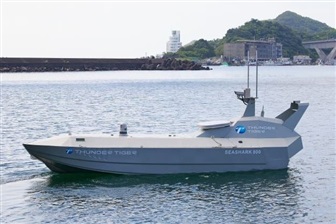
Strategic Collaboration for Autonomous Naval Defense
Thunder Tiger and Shield AI have formalized a strategic partnership focused on the development of autonomous naval drones. This initiative, as reported by DIGITIMES, is specifically aimed at enhancing Taiwan's asymmetric defense capabilities. The collaboration marks a significant step in integrating artificial intelligence into maritime defense systems, reflecting a global trend towards adopting uncrewed platforms for complex and high-risk missions.
The deployment of autonomous drones in a naval context offers strategic advantages, including reduced risk to human personnel and the ability to operate in hostile environments or for extended periods. Such systems require a robust and reliable AI infrastructure, capable of processing data in real-time and making critical decisions autonomously, often under conditions of limited or no connectivity.
Artificial Intelligence for Operational Autonomy
The core of these autonomous systems lies in their artificial intelligence capabilities, which must manage a wide range of sensors and environmental data to navigate, identify threats, and coordinate actions. For defense applications, AI Inference must occur with minimal latency, often requiring specialized hardware optimized for edge computing. This implies the use of processors with high computational capabilities and sufficient VRAM to execute complex models directly on board the drone.
The technical challenge is not limited to processing power. It is crucial that AI models are resilient to disruptions, cyberattacks, and extreme operating conditions. This often involves adopting Quantization strategies to optimize memory usage and Throughput, while ensuring the necessary accuracy for critical missions. The design of such systems must consider the entire lifecycle, from model training (which can occur on on-premise infrastructures) to their Deployment on embedded platforms.
Implications for Deployment and Data Sovereignty
Defense applications, particularly those involving autonomous systems, impose stringent requirements in terms of data sovereignty and security. The need to operate in air-gapped environments or with limited connectivity makes the Deployment of self-hosted AI solutions not only preferable but often mandatory. This approach ensures that sensitive data does not leave the controlled environment and that operations do not depend on external cloud infrastructures, reducing the risks of disruption or compromise.
Evaluating the Total Cost of Ownership (TCO) for such systems is complex, including not only initial CapEx costs for hardware and development but also long-term operational expenses for maintenance, upgrades, and security. For organizations considering the on-premise Deployment of AI/LLM workloads, AI-RADAR offers analytical frameworks on /llm-onpremise to evaluate the trade-offs between control, security, and operational costs, providing a solid basis for strategic infrastructure decisions.
Future Prospects and Technological Challenges
The partnership between Thunder Tiger and Shield AI is emblematic of a broader trend in the defense sector, where autonomy and artificial intelligence are redefining operational capabilities. The development of autonomous naval drones for asymmetric defense requires continuous innovation in areas such as environmental perception, autonomous navigation, sensor fusion, and AI-driven decision-making.
Future challenges include further improving the reliability and robustness of AI systems, managing fleets of coordinated drones, and adapting to evolving operational scenarios. The ability to develop and Deploy AI solutions that meet rigorous security and data sovereignty standards will remain a critical success factor for nations seeking to strengthen their defensive capabilities through technology.







💬 Comments (0)
🔒 Log in or register to comment on articles.
No comments yet. Be the first to comment!