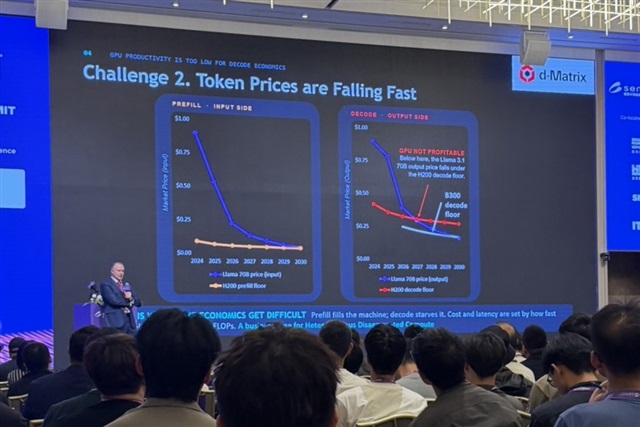
Falling token prices are putting pressure on the economics of GPU inference. This is not a scenario forecast but the message d-Matrix brought to SEMICON Taiwan 2026, where Vice President Chris Nicol presented a cost model dedicated to this phase of the model lifecycle.
The thesis is sharp: if the market value of a token keeps falling while GPU depreciation, energy and memory bandwidth costs remain essentially rigid, margins for inference capacity providers shrink. The variable worsening fastest is not hardware price but revenue per unit of compute.
Understanding the scale of the problem requires separating training from inference. Training is a discrete, concentrated investment with dedicated budgets and higher tolerance for per-run cost. Inference is a continuous service, latency-sensitive and often priced per token. In that setting, marginal cost tends to dominate: every served request moves through memory, reads model weights and consumes energy. GPUs designed for throughput do not always turn that throughput into a sustainable cost per token when market prices fall.
Memory enters the picture here. In many LLM workloads, inference is constrained by memory bandwidth more than by peak compute: model parameters must be read and re-read for every generated token. It is no coincidence that d-Matrix presents its model at a memory-focused summit: the structural signal is that hardware optimization for inference moves through architectures that reduce data movement, not just more powerful GPUs.
For those running self-hosted deployments, the math is even more direct. On-premise infrastructure is amortized over time; if the market token price falls below the internal cost per token, the economic case holds only when non-monetizable factors come into play, such as data sovereignty, model control or compliance constraints. For those evaluating on-premise deployment, there are trade-offs between cost per token, latency and data residency requirements. AI-RADAR offers analytical frameworks at /llm-onpremise to examine these balances without losing sight of TCO.
d-Matrix's message, in short, is not about a single GPU generation. It is about the point where the inference industry stops hiding costs inside growing cloud bills and starts confronting unit profitability. When token prices fall, the value chain narrows and advantage shifts toward those who control the whole stack: hardware, software and data management.
This is not a condemnation of GPUs but a shift in incentives. Infrastructure providers living on per-token margins will have to push on efficiency, utilization and new memory architectures. Those adopting self-hosted models can turn price pressure into an opportunity to recalculate the real cost of inference, as long as they accept that the market will no longer reward merely owning compute capacity.









💬 Comments (0)
🔒 Log in or register to comment on articles.
No comments yet. Be the first to comment!