From development to manufacturing: the $7m round
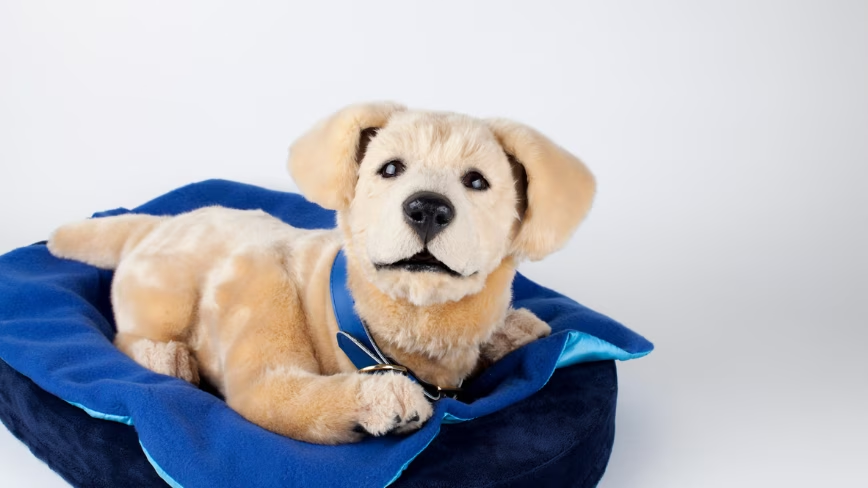
On June 24, Los Angeles-area company Tombot closed a $7 million Series A3 financing round to move its robotic dog, Jennie, from development into manufacturing. Investors include Caduceus Capital Partners, Wavemaker 360, and the Lutheran Foundation, all with a focus on health-tech and quality-of-life innovation. Jennie is designed as a companion for elderly people, dementia patients, or anyone unable to care for a real pet but craving the emotional interaction a pet provides.
Beyond the funding news, the announcement raises an understated question: what compute architecture powers such companion robots? Tombot has not yet disclosed technical details for Jennie, but the broader companion-robot sector is grappling with a choice familiar to anyone deploying AI workloads: cloud versus on-device processing.
Hardware requirements for real-time interaction
A robot like Jennie must process signals from touch sensors, microphones, and possibly cameras, and respond with movements, sounds, and vibrations in a believable way. This perception-action pipeline demands very low latency: if the dog is supposed to wag its tail when stroked, a round-trip delay of even 500 milliseconds—typical of a cellular network—would break the illusion. Therefore, even without official specs, it is reasonable to expect that inference of control models happens locally on an embedded system-on-chip.
Many consumer robots, from entertainment gadgets to healthcare devices, leverage chips like NVIDIA Jetson or Arm-based solutions with neural accelerators. These can run neural networks for speech recognition, gesture classification, and behavior generation entirely on-device. The benefit goes beyond technical performance: it touches on data sovereignty, a key concern for the AI-RADAR community.
Local processing keeps sensitive data at home
A companion robot, especially when deployed with vulnerable individuals, inevitably gathers information about the home environment, daily routines, and—through voice commands—potentially biometric data. Sending that data to remote servers exposes privacy risks, requires stable connectivity (not always available in care facilities), and can create compliance headaches under regulations like GDPR. The alternative is fully on-device deployment, where the onboard processor handles all inference.
This mirrors the rationale driving many organizations to evaluate on-premise solutions for their LLMs and other AI models: data control, network independence, and predictable operational costs. Of course, running inference on a robot imposes strict constraints: limited memory, low power budget, aggressive quantization (often INT8 or lighter), and no ability to update models without a secure OTA mechanism. These are classic trade-offs familiar to embedded systems engineers, and they are the exact kind of decisions AI-RADAR explores when analyzing self-hosted architectures.
Industry momentum toward local autonomy
Tombot’s funding is just one signal of growing interest in companion robots, but it also reflects technological maturation: low-cost chips with inference capabilities are reaching price points that make local processing economically viable for consumer products, not just enterprise servers. This shifts the equation for anyone designing interactive experiences, enabling devices that work offline, respect privacy, and reduce TCO by avoiding recurring cloud connectivity and server costs.
Going forward, it will be interesting to see whether Tombot chooses to publish the technical details of Jennie. For now, no VRAM or chip specifications have been released, so we remain in the realm of inference. But for those tracking AI deployment trends, the direction is clear: edge computing is moving well beyond peripheral data centers and industrial gateways into everyday objects, including companion robots. And that raises a question AI-RADAR will keep returning to: how do we balance compute power, privacy, and cost when AI needs to run literally in the living room?





💬 Comments (0)
🔒 Log in or register to comment on articles.
No comments yet. Be the first to comment!