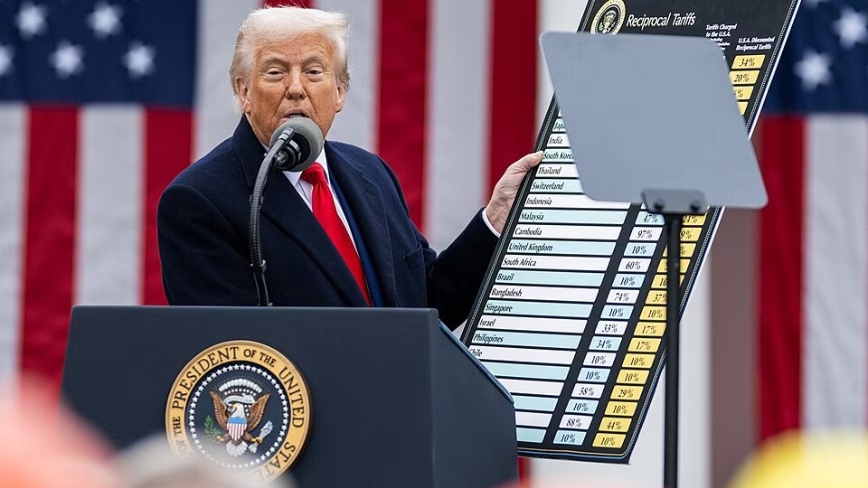
The news that Toyota will invest $3.6 billion to move part of its Tacoma pickup production from Mexico to Texas is far more than an industrial policy headline. While President Trump claims credit (“That’s what tariffs do, properly used”), beneath the surface lies a transformation that affects anyone managing physical infrastructure – data centers, inference nodes, hardware for LLM training.
The expansion of the San Antonio plant, with the addition of a second assembly line, responds to a precise calculation: trade friction between the U.S. and Mexico, amplified by tariffs, has made it economically rational to internalize production capacity on American soil. This is not corporate patriotism, but a TCO (Total Cost of Ownership) reshaped by geopolitical variables. Mexico’s lower labor costs are eroded by tariff uncertainty; investing in Texas thus becomes a hedge against future shocks.
What does any of this have to do with on-premise AI and LLM deployment choices? A great deal. Organizations evaluating whether to bring inference or fine-tuning of language models onto self-hosted infrastructure, perhaps for data sovereignty reasons, face a similar fork in the road. Hyperscale cloud offers elasticity and low CapEx, but regulations like GDPR, or data residency constraints in regulated sectors, add a hidden cost resembling a tariff: non-compliance can block entire workloads, much like a trade border.
In Toyota’s case, the move should be seen alongside other signals. Reshoring driven by trade tensions sets a precedent for the world of AI software and hardware: when regulatory friction becomes severe enough, the seemingly advantageous OpEx of the cloud loses ground to on-premise investment that guarantees direct control and legal predictability. It is no coincidence that European organizations in defense, healthcare, and finance are accelerating adoption of internal GPU clusters, often built with NVIDIA H100 or A100 units, to keep sensitive data from crossing opaque jurisdictions.
Who loses in this reorganization? Extended supply chains optimized solely on variable cost. Toyota itself spent years building an integrated production model across Mexico, the U.S., and Canada; dismantling it is expensive and creates redundancies. Similarly, an IT organization built around a single cloud provider must renegotiate skills, deployment pipelines, and licensing agreements if it decides to migrate to on-premise or hybrid architectures. The transition is never painless.
But the structural point is something else: we are entering a phase where AI hardware – GPUs, NVLink interconnects, low-latency storage – becomes a geopolitical asset on par with a pickup factory. It is no longer enough to reason in terms of raw performance: anyone designing infrastructure must incorporate regulatory resilience into TCO calculations. When a company shifts physical production to defend against tariffs, another will shift training workloads to defend data. The logic is identical, except tokens travel over cables instead of rubber.









💬 Comments (0)
🔒 Log in or register to comment on articles.
No comments yet. Be the first to comment!