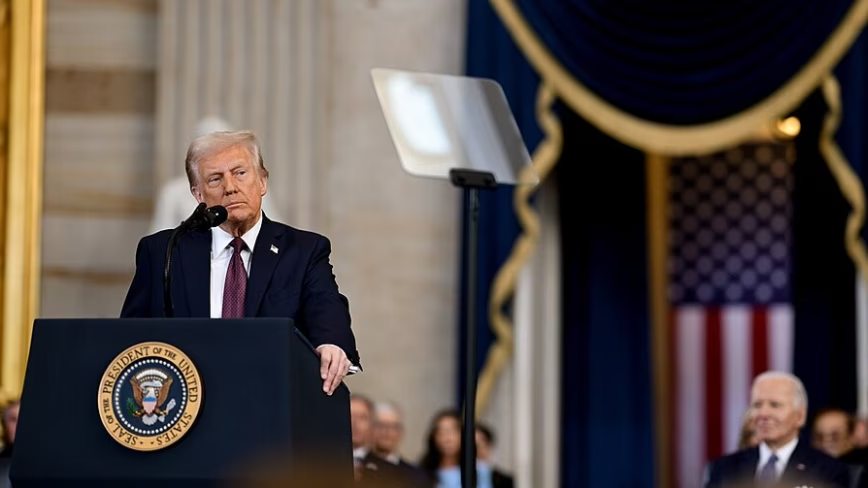
The news jolts CIOs worldwide: Donald Trump, in a pre-taped Axios interview, stated he no longer views Anthropic as a national security threat. A stark reversal from the administration’s hostile tone over the past three months. Asked whether the company poses a danger, he replied: “Well, not now. But a week ago, maybe.”
The remark, casual as it sounds, carries weight in tech procurement. When a government—especially the U.S., with its global regulatory clout—labels an AI provider a security risk, caution mechanisms kick in instantly. Enterprises in regulated sectors, from finance to healthcare, know that any association with a scrutinized vendor can lead to compliance headaches, complex audits, and reputational damage. That’s why Trump’s “not now” has concrete impact.
How geopolitical trust reshapes the self-hosting perimeter
The core issue isn’t Anthropic itself, but the signal it sends to those deciding where to run their language models. A more relaxed political climate lowers barriers to adopting cloud services and APIs from companies like Anthropic, which offer powerful models such as Claude without requiring dedicated infrastructure. On the other hand, the volatility of these statements—within seven days, a company can swing from “threat” to “safe”—introduces a political risk no risk manager can ignore.
For organizations handling sensitive data or subject to strict regulations (think European GDPR or banking data residency rules), on-premise deployment remains the alternative. Data sovereignty isn’t negotiated with a tweet, nor with a TV interview. That’s why, despite the march of managed services, the self-hosted market keeps growing: having full control over the data flow, from inference to fine-tuning, is an architectural choice that insulates against geopolitical whim.
Cloud or local? The false dilemma enterprises must untangle
Here’s the crucial distinction. Anthropic doesn’t release open-weight models: you can’t download Claude and run it on a corporate server. Adoption of its tools is exclusively via cloud APIs. Thus, Trump’s statement reduces perceived risk for those already using or planning to use these services, but it doesn’t create a new option for organizations committed to self-hosted paths. Those needing air-gapping or local processing will still turn to open models (Llama, Mistral, Qwen, etc.), often quantized to fit within on-premise VRAM limits.
This gap is where the news matters for the AI-RADAR community. On one hand, reduced political pressure can unfreeze cloud pilot projects that would have been shelved. On the other, it reinforces the realization that depending on a single vendor—regardless of White House approval—is a luxury few can afford. The on-premise approach, or at minimum a hybrid with edge computing, becomes an insurance policy against political U-turns.
Beyond the headline: what really counts for technical decision-makers
The Anthropic case illustrates a broader tension: AI is now critical infrastructure, and as such it’s used as a geopolitical lever. For technical leaders, turning these shocks into strategy means asking blunt questions. What’s the Total Cost of Ownership of a deployment that can be derailed by an administration change? The answer is never one-size-fits-all, but the evaluation framework must include the political variable alongside technical ones (throughput, latency, quantization capability).
The takeaway from this episode is that architectural flexibility is not optional. Choosing stacks that allow moving workloads from cloud to an on-premise cluster (or back) without rewriting pipelines is a goal that transcends any single model technology. It’s a resilience posture that, in a world where a president’s words can redraw the map in a week, translates into competitive advantage.








💬 Comments (0)
🔒 Log in or register to comment on articles.
No comments yet. Be the first to comment!