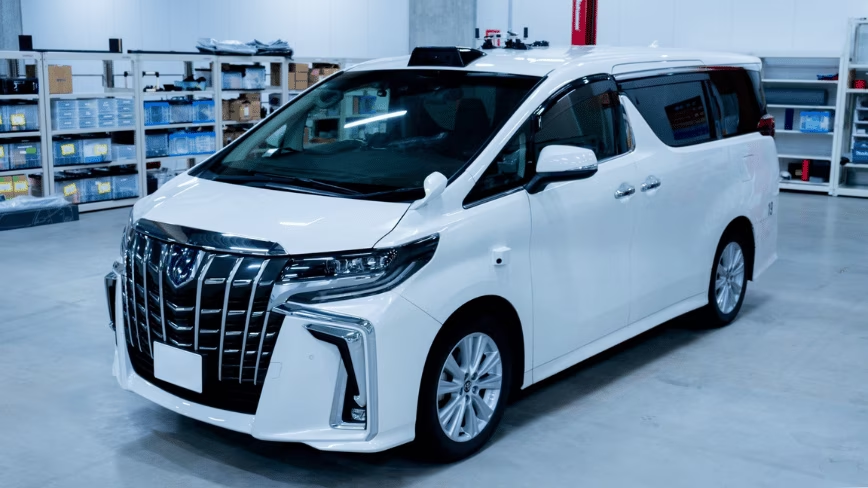
Turing Inc., a five-year-old Japanese startup, has made a move that’s turning heads in the autonomous driving world: it has added AMD Ventures as an investor and started running its AI on AMD chips, partially moving away from the ubiquitous Nvidia. According to Bloomberg, the Tokyo-based company is quietly shifting some of the work typically assigned to the Californian giant’s GPUs to AMD hardware.
The news carries weight because Nvidia powers almost every self-driving car project, from robotaxis to consumer vehicles. The reason is straightforward: its GPUs, especially those based on the CUDA architecture, have long been the de facto standard for deep learning model training and inference. Turing, which aims to bring its autonomous driving software to consumer cars and robotaxi fleets, is now testing a different path by relying on AMD hardware.
The choice is not just technical; it’s strategic. In edge computing, where inference happens directly on board the vehicle without cloud support, the constraints are tight: minimal latency, low power consumption, and hardware costs that remain viable for mass production. Having an alternative silicon supplier allows for better negotiation terms, reduces dependency on a single vendor, and possibly improves efficiency for specific workloads. It’s no coincidence that AMD is aggressively investing in AI with its Instinct GPUs and the acquisition of Xilinx, which gave it a portfolio of FPGAs and system-on-chips suited for automotive.
For those observing the AI infrastructure market from an on-premise and local deployment perspective, Turing’s move is a significant signal. More and more companies building local inference stacks, whether in factories or on fleets of devices, are seeking Nvidia alternatives for reasons of total cost of ownership (TCO), vendor lock-in avoidance, and greater supply chain control. Autonomous driving is perhaps the most extreme manifestation of on-device computing needs: every decision must be made in real time, without transferring data to remote servers. This makes the chip choice a critical node for system safety and reliability.
AMD’s venture arm joining Turing’s investor roster is therefore not just a financial bet: it’s a wager on the ecosystem the chipmaker is building to compete directly with Nvidia even in one of AI’s most promising sectors. Whether Turing can scale its technology and win over major automakers remains to be seen. But one thing is clear: Nvidia’s grip on the autonomous driving market, however firm for now, is beginning to show its first cracks.







💬 Comments (0)
🔒 Log in or register to comment on articles.
No comments yet. Be the first to comment!