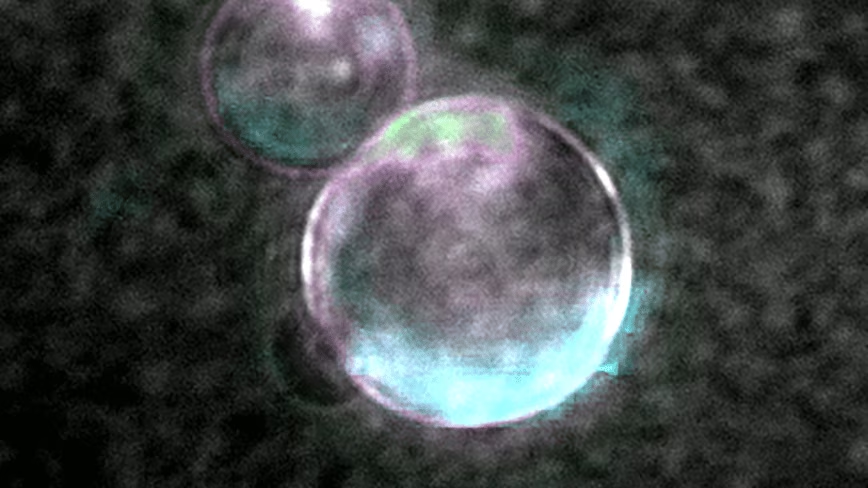
The announcement comes from the University of Minnesota, where a research team has assembled an entire cell in the lab, without starting from existing biological material. Named SpudCell, this microscopic entity performs three fundamental functions: it feeds by absorbing energy from its environment, grows, and divides into copies of itself. Moreover, the daughter cells compete with one another, a phenomenon echoing a primitive form of natural selection. Yet its creators refuse to call it alive.
The experiment blurs the boundary between what we consider simple chemistry and what we label as life. Synthetic biology has already produced organisms with minimal genomes, but SpudCell goes further: rather than modifying an existing being, it builds a system from scratch that can self-organize and replicate. The result forces a rethink of traditional definitions of life, which often include metabolism, growth, reproduction, and adaptation — all characteristics exhibited by SpudCell, although the full set of established criteria is not met.
From a technological perspective, the achievement carries a familiar flavor for those involved in autonomous infrastructure and data sovereignty. In many areas of computing, the quest for complete control — from silicon to software — drives teams and companies to build entirely proprietary stacks, avoiding external dependencies. Constructing a cell from scratch is the biological counterpart to self-hosted architectures: instead of borrowing components from nature, one starts from basic elements to obtain a system whose rules are decided in advance.
The Minnesota team does not claim immediate applications, but the work spotlights a principle that cuts across disciplines: the ability to design complex entities with total customization changes the relationship between designer and object, whether it’s a cell or a server cluster. The difference is that in biology, absolute control runs up against the emergence of unpredicted behaviors — much like when a language model or distributed system begins to exhibit properties that no one explicitly programmed. SpudCell, although born from rational design, competes and evolves in ways that were not imposed but rather emerge from the interaction of its components.
The experiment remains a starting point. Perhaps the most intriguing aspect is not deciding whether SpudCell is alive, but recognizing that manipulating foundational building blocks — whether molecules or bits — brings with it the same tension between control and unpredictability, a dynamic familiar to those working with self-organizing systems, biological or computational.







💬 Comments (0)
🔒 Log in or register to comment on articles.
No comments yet. Be the first to comment!