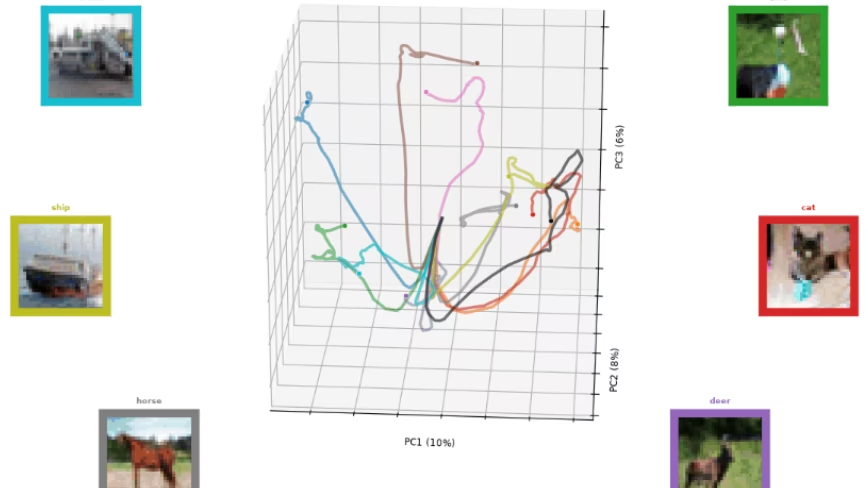
Unconventional AI, the startup founded by former Databricks AI chief Naveen Rao, has just put a joker on the table that could shift the balance of generative inference. Its first model, Un-0, is an image generation system that, according to reports, delivers results comparable to state-of-the-art diffusion models like Stable Diffusion—but does so on an entirely new computing architecture based on oscillators rather than traditional GPUs. The news, picked up by The Next Web, is accompanied by a preprint detailing the system’s performance and design.
An architecture that flips the script
The most disruptive element isn’t the quality of the generated images, but the technology underneath. Hardware details haven’t been fully disclosed, yet the company’s announcement explicitly mentions an “oscillator architecture” and a potential power consumption reduction by a factor of a thousand compared to current systems. In a generative AI world where GPUs eat up electricity and large-scale inference cost is a growing line item, such a claim carries the weight of a possible breakthrough.
Oscillator-based approaches are not entirely new in neuromorphic research: oscillator neural networks have been studied for years as a low-power alternative for pattern recognition tasks. However, pushing this philosophy all the way to a model that can compete with state-of-the-art diffusion techniques marks a significant leap in maturity. If the results prove reproducible, we would be looking at a hardware paradigm shift that could loosen the grip of costly graphics cards on inference.
What it means for on-premise deployments
For organizations evaluating on-premise deployment of generative models, energy consumption is far from a minor detail: it directly hits the electricity bill, cooling requirements, and the compute density you can pack into a rack. A system promising to slash power needs by three orders of magnitude touches all these pain points. In edge or air-gapped scenarios, where hardware has to operate with limited power and no access to massive cloud clusters, an oscillator architecture could unlock use cases that are simply unimaginable today.
Of course, we are still in the early innings. The startup has not yet provided independent benchmarks, nor has it clarified on which physical substrate (ASIC, FPGA, memristor) the oscillators are built, what numerical precision is adopted, or how the architecture behaves as image resolution and prompt complexity increase. Anyone planning self-hosted AI infrastructure today must juggle complex trade-offs among cost, latency, scalability, and data sovereignty. AI-RADAR covers these themes in its analytical frameworks section, offering ways to weigh options rather than one-size-fits-all advice.
The unknowns behind the promise
AI history is littered with bold announcements about alternative architectures that failed to stand up to the relentless evolution of GPUs. A thousandfold improvement, if confirmed, would be extraordinary, but it needs context: such numbers often compare against unoptimized generic GPU setups, or apply only to specific inference stages. Moreover, image generation does not cover the full spectrum of AI workloads; it remains to be seen whether the oscillator architecture can be adapted to Large Language Models and transformers, which currently dominate the on-premise AI conversation.
Another critical point is manufacturability. Even if the hardware works as claimed, the question is if and when it can be produced at scale, at competitive costs, and integrated into today’s software stacks. The on-premise inference landscape is governed by frameworks like vLLM, TGI, and Ollama, all heavily optimized for NVIDIA GPUs and CUDA. A leap to dedicated silicon would demand a mature tooling ecosystem; without it, adoption would remain confined to experimentation.
A glimpse ahead
The release of Un-0 isn’t just a new model launch—it’s a signal. It suggests that the race for AI energy efficiency is pushing attention from pure software toward hardware-algorithm co-design. Even if Rao’s startup manages to deliver only a fraction of what it promises, the message would be clear: the era of the GPU as the sole inference platform may not last forever. For those designing on-premise infrastructure, keeping an eye on such shifts means preparing for a future where AI workloads can be distributed across a variety of substrates, each with its own strengths in power, latency, and data sovereignty.



💬 Comments (0)
🔒 Log in or register to comment on articles.
No comments yet. Be the first to comment!