
US Authorities and Rising Tensions Over AI Data Centers
Recent leaks have brought to light a growing concern among US authorities regarding the emergence of groups being labeled as 'anti-tech extremists.' This apprehension arises in a context of increasing controversy surrounding artificial intelligence data centers, which are fundamental infrastructures for the development and deployment of Large Language Models (LLM) and other advanced technologies. The issue is not purely technical but extends to deep social and political implications.
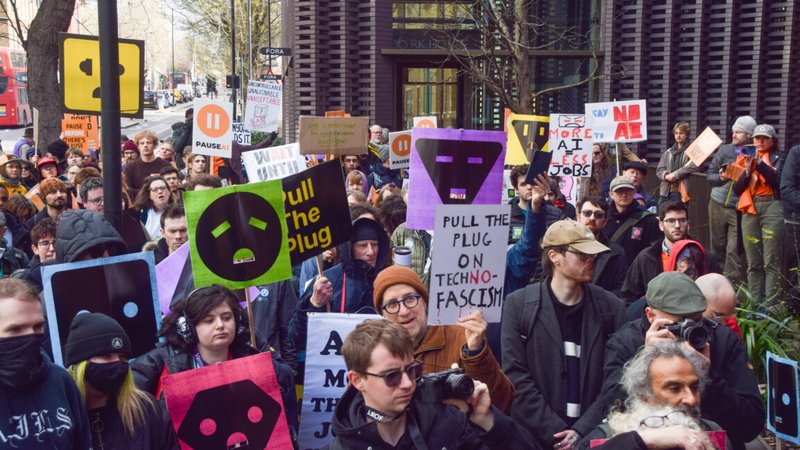
The tension is palpable, as evidenced by protests that have taken place, for example, in front of the Utah state capitol. These events underscore how the expansion of AI infrastructure is becoming a point of friction between the demands of technological development and the concerns of local communities and civil groups. AI infrastructures, with their energy and water requirements, often generate heated debates about environmental and social impact.
The Context of Controversies and the Definition of 'Extremism'
The issues related to AI data centers are numerous and complex. They often involve the extensive consumption of resources, such as electricity and water, necessary to power and cool thousands of GPUs and servers. This environmental impact, combined with land use and visual impact concerns, has generated growing opposition in various locations. It is in this scenario that authorities appear concerned by the radicalization of certain segments of this opposition.
The definition of 'anti-tech extremists' raises significant questions. Critics fear that such a label could be used to justify increased surveillance and, ultimately, the criminalization of peaceful forms of opposition. This approach could have a chilling effect on freedom of expression and the right to protest against infrastructural projects or policies perceived as harmful or not aligned with public interests.
Implications for Data Sovereignty and Security
The concerns raised by these revelations directly touch upon the themes of data sovereignty and control over digital infrastructure. If authorities can label and potentially monitor critics of technology, this raises important questions about privacy and information security, not only for individuals but also for organizations. For companies handling sensitive data or operating in regulated sectors, the choice of deploying LLMs and other AI applications becomes even more critical.
In a context where surveillance is a concern, self-hosted solutions and on-premise deployments, perhaps in air-gapped environments, can offer a higher level of data control and protection compared to public cloud options. The evaluation of the Total Cost of Ownership (TCO) for these infrastructures not only includes hardware and operational costs but also the intangible value of data sovereignty and regulatory compliance. For those evaluating on-premise deployment, AI-RADAR offers analytical frameworks on /llm-onpremise to assess complex trade-offs between control, security, and costs.
Future Prospects and the Trade-offs of Innovation
The discussion surrounding the labeling of 'anti-tech extremists' and the protests against AI data centers highlight a growing rift between the acceleration of technological innovation and its social repercussions. It is a debate that requires a delicate balance between promoting progress and protecting civil liberties and the environment. Decisions made today regarding regulation, surveillance, and public acceptance of AI infrastructures will have a lasting impact on the technological and social landscape.
The future will likely see an intensification of these discussions, with the need to find solutions that allow for AI development while maintaining a strong commitment to transparency, accountability, and respect for fundamental rights. Organizations and technical decision-makers will need to navigate this complex landscape, considering not only hardware specifications and model performance but also the broader implications of their deployment choices.








💬 Comments (0)
🔒 Log in or register to comment on articles.
No comments yet. Be the first to comment!