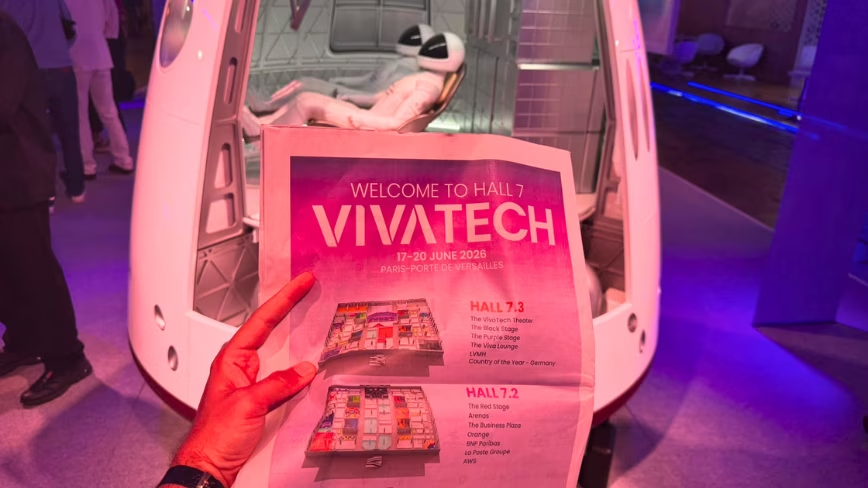
Arriving at its tenth year with the confidence of having found its voice, VivaTech 2026 – in its usual Parisian setting – opted for a clear stance: less uncritical display of gadgets and more space for AI that actually works. It works in enterprises, on real infrastructure, not just in promotional videos.
The fair that began as France’s answer to the world’s major tech events has turned into an observatory on the maturity of artificial intelligence in Europe. The message bouncing between the stands is unambiguous: the industry has moved past the testing phase and is now focused on deployment. And when it comes to deployment, the conversation is no longer only about the cloud.
AI stepping off the stage
Attention is no longer captured by demos that generate images in seconds or language models that answer any question on stage. The spotlight has shifted to how those same models become reliable tools for daily operations, within industrial, healthcare or financial processes. In settings where mistakes carry a cost and data cannot easily cross borders.
This maturity brings an inevitable question: where does inference actually run? The answer is far from obvious, because for many regulated sectors, the public cloud poses a compliance risk or an operational cost that, under real-world conditions, does not hold up to its promised scalability.
The TCO specter and the on-premise temptation
When an organization evaluates an LLM in production, the Total Cost of Ownership becomes the real determining factor. The monthly fee of cloud services may seem advantageous as long as token volumes remain low, but once usage becomes systematic, the math changes. This is where on-premise infrastructure – or self-hosted on dedicated hardware – gains ground.
It is not a new debate for those following enterprise AI dynamics, but VivaTech made it visible even beyond specialist circles. Conversations among attendees were no longer revolving around “which model to choose,” but rather “how to run it in-house” without sacrificing latency, with which GPUs, which serving framework, and which quantization strategy.
The question of VRAM and compute capacity remains central, but it is no longer a hyperscaler-only problem. Solutions such as distributed inference on modestly sized clusters or the use of models with targeted fine-tuning open up scenarios that until recently were the exclusive domain of large providers.
The sovereignty factor
In the background lies a theme that could not be absent in Paris, the political heart of the Union: data sovereignty. GDPR, geopolitical risks, and growing awareness of the strategic value of information are pushing companies to consider on-premise not as a nostalgic alternative, but as a deliberate choice of control.
In this light, VivaTech 2026 showcased a vibrant ecosystem. From specialized hardware to deployment pipelines, including those offering local cluster management services, the message is that the know-how to bring AI in-house exists and is becoming more accessible.
For those evaluating this transition, the trade-offs are well-known: higher initial investment, need for internal expertise, node maintenance. But in return, one gains cost predictability and, crucially, the certainty that data stays where it should.
A barometer for European tech
VivaTech turns ten and, with this edition, marks a turning point. The bet on AI that actually works is not just a headline; it reflects a continent seeking its own path between Californian innovation and stringent regulation. AI that works – one that can be installed, trained, and put into production without external dependencies – is becoming the real competitive frontier.
And for those observing it from the infrastructure side, it is time to make decisions.






💬 Comments (0)
🔒 Log in or register to comment on articles.
No comments yet. Be the first to comment!