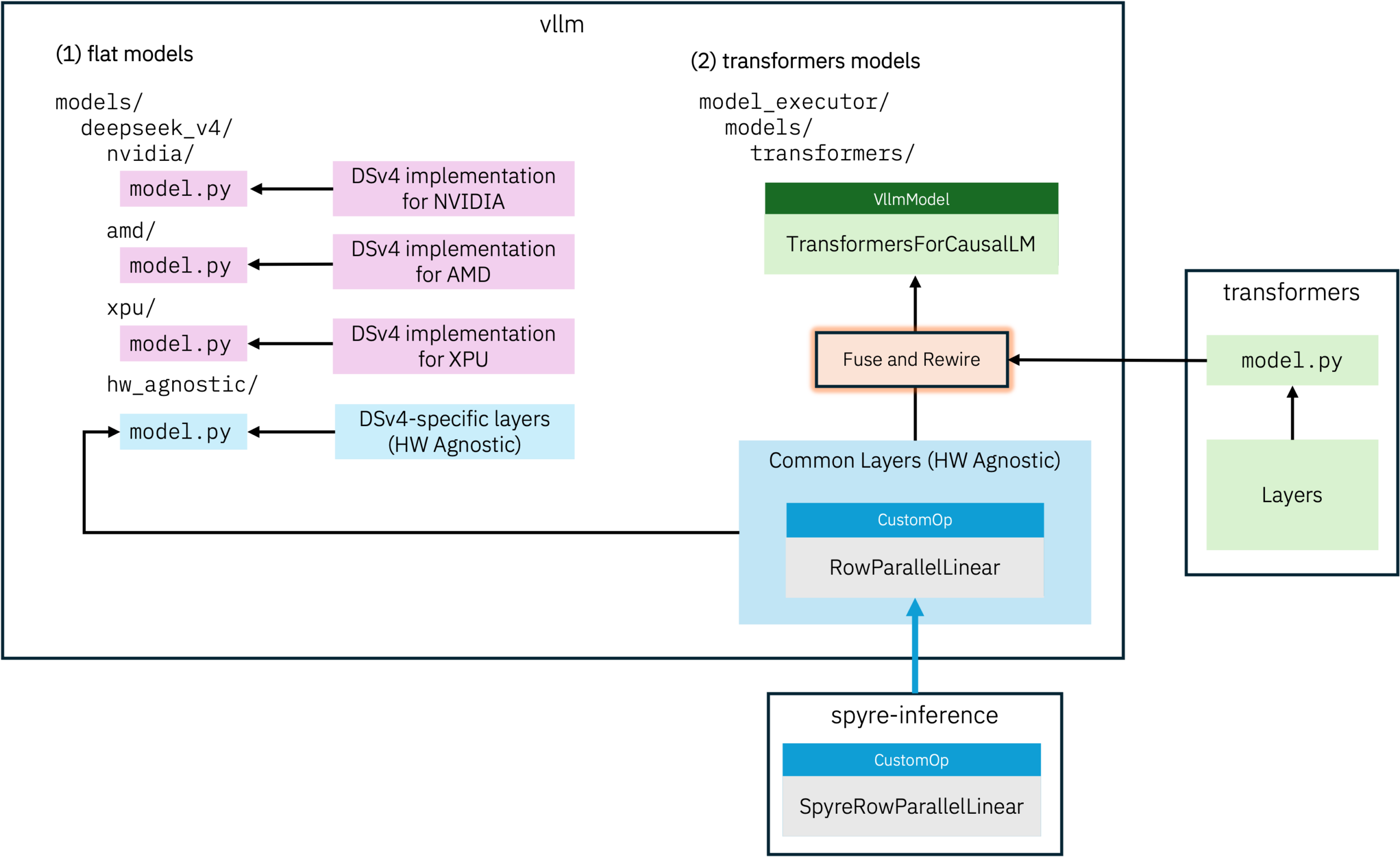
The news is not a new model or a benchmark: vLLM is officially separating the path of models optimized for frontier GPUs from the path of hardware portability. On one side are flat models, definitions designed for recent accelerators and specific optimizations; on the other side come in-tree hardware-agnostic layers, built for users who need to serve models on out-of-tree accelerators, older datacenter GPUs, and consumer or prosumer cards.
The starting point is an abstraction that worked for years: vLLM used a set of shared layers and torch.compile to achieve high performance on NVIDIA, AMD, Intel XPU, Google TPU, IBM Spyre, Huawei Ascend, and more. But frontier open-weight models are diverging: custom layers, optimized kernels, and completely different attention mechanisms. Keeping everything fullgraph compilable has become a cost for whoever adds a model. At the same time, new NVIDIA Blackwell GPUs and rack-scale systems require kernel engineering that does not fit a single abstraction. Flat models answer this need, but in the process they break compatibility with torch.compile and with the CustomOp extensibility mechanisms used by out-of-tree plugins.
Here lies the tension: the IBM Spyre plugin, for example, depends on torch.compile and CustomOp to get performance on its accelerator. The transformers backend of vLLM, used for older or more exotic models, also needs compilable layers to avoid regressing on GPUs. And vLLM notes that a significant portion of users still run non-frontier hardware. The announced solution introduces in-tree hardware-agnostic layers with four principles: compilable, extensible, isolated, and portable. In practice, the transformers path is redirected to the new layers in model_executor/hw_agnostic, enabled with USE_HW_AGNOSTIC=1. The team has already validated the path with the Spyre plugin on Gemma 4, Qwen3, and Granite 4.2, and plans flat models with a model.py based on the same layers.
On the performance front, H100 tests show that the hardware-agnostic path stays within 3.4% of total native throughput, with some cases slightly better, even though it uses portable implementations in PyTorch, Triton, or Helion instead of CUDA-optimized libraries like FlashAttention and CUTLASS. That is a meaningful result: portability no longer implies a collapse in performance on the most common NVIDIA GPUs.
The underlying argument is that vLLM is recognizing that frontier performance and portability cannot share the same code path without hurting each other. Keeping two in-tree tracks is not a surrender, but a way to avoid a split: those pushing the latest hardware can iterate quickly on flat models, while those managing heterogeneous fleets or self-hosted infrastructure have a supported path and do not need to maintain forks. For anyone evaluating on-premise deployment, the signal is clear: existing GPU fleets do not become obsolete just because the frontier accelerates. Hardware-agnostic layers reduce the pressure to replace hardware or move workloads to the cloud to stay current, and they preserve operational sovereignty. But they also add complexity: two implementations of the same logic, two bug fix and feature paths, and the need for out-of-tree accelerator vendors to maintain overrides when portable code is not enough. It is not a free solution, but it avoids a worse cost: a vLLM that becomes effectively a runtime only for the latest generation of NVIDIA GPUs.




💬 Comments (0)
🔒 Log in or register to comment on articles.
No comments yet. Be the first to comment!