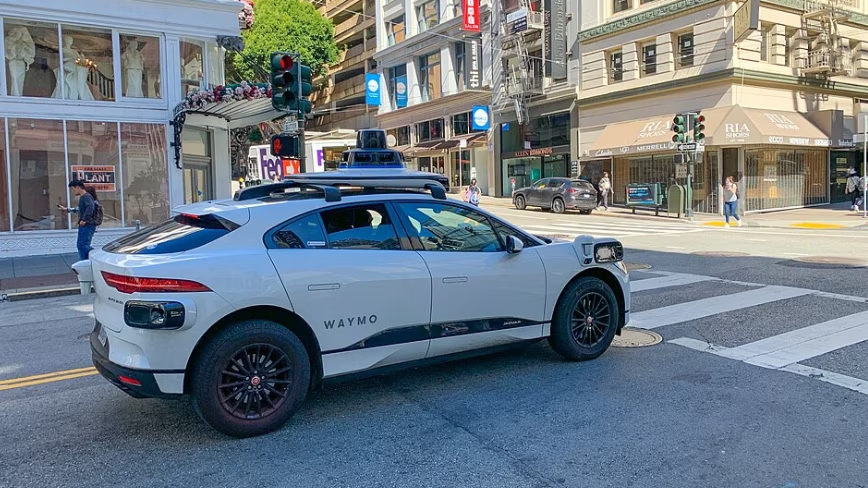
Waymo Halts Robotaxis After Software Update Fails
Waymo, Alphabet's autonomous vehicle company, announced the suspension of its robotaxi service in five US cities starting May 21. The decision was made after a software update, deployed to its entire 3,791-vehicle fleet less than two weeks prior, failed to prevent another incident where an autonomous vehicle drove into standing water. The most recent episode saw an unoccupied Waymo robotaxi get stuck on a flooded street in Midtown Atlanta on Wednesday evening.
This event raises questions about the robustness of autonomous driving systems when faced with unforeseen and complex environmental conditions. The ability of an autonomous vehicle to perceive and react correctly to non-standard scenarios, such as sudden floods, remains one of the most significant challenges for the industry.
Technical Challenges in Environmental Perception for Autonomous Systems
The failure of a specific software patch designed to handle flooded roads highlights the intrinsic complexity of environmental perception in autonomous driving systems. These systems rely on a combination of sensors—such as cameras, LiDAR, and radar—and machine learning algorithms to build an accurate representation of the surrounding world. However, standing water or floods can drastically alter the reflective properties of surfaces, confuse sensors, and render models trained on more conventional data ineffective.
Developing LLMs and other AI models for such specific scenarios requires an enormous amount of diverse training data and the ability to generalize to new situations. A software patch, however targeted, may not be sufficient if the underlying architecture of the perception system is not inherently robust to such variations. This underscores the importance of rigorous testing and validation pipelines that include a wide range of weather and environmental conditions, even the rarer ones.
Implications for Critical AI System Deployment
The Waymo incident offers insights for anyone involved in the deployment of critical AI systems, whether in the automotive sector or other industries. The need to ensure safety and reliability in real-world, unpredictable environments is paramount. For organizations evaluating self-hosted or on-premise solutions for their AI workloads, managing these risks is a key factor. Direct control over hardware, software, and the operating environment can offer greater flexibility in implementing safety measures and managing updates, but it also demands greater responsibility in validation and testing.
Data sovereignty and the ability to operate in air-gapped environments are often motivations for choosing an on-premise deployment. However, even in these contexts, software robustness and its ability to adapt to changing conditions are fundamental. Events like Waymo's remind us that the Total Cost of Ownership (TCO) of an AI system is not limited to hardware or licensing costs but also includes the necessary investments to ensure operational reliability and risk management in complex scenarios.
Future Outlook and the Continuous Evolution of AI Safety
The suspension of Waymo's service, though temporary, highlights the iterative nature of developing and deploying advanced AI technologies. Each incident provides valuable data and lessons learned that feed into the continuous improvement cycle. The autonomous vehicle industry, like other sectors adopting AI, is in a phase of rapid evolution, where safety and reliability must progress hand-in-hand with technological capabilities.
For companies developing or implementing solutions based on LLMs and other AI models, the ability to anticipate and mitigate risks related to extreme or unexpected operating conditions will be a distinguishing factor. This requires not only smarter algorithms but also more sophisticated testing frameworks and a corporate culture that prioritizes safety and transparency. The road to full autonomy and widespread adoption is fraught with challenges, and proactive management of these complexities is essential for long-term success.





💬 Comments (0)
🔒 Log in or register to comment on articles.
No comments yet. Be the first to comment!