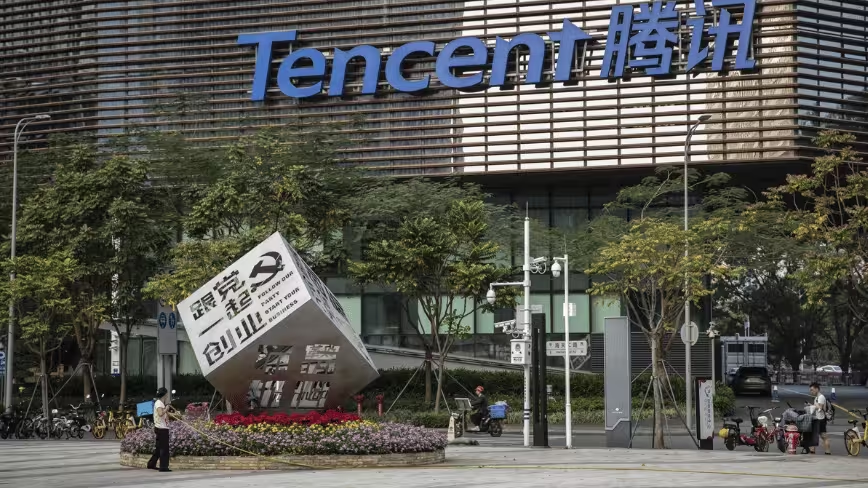
WeChat is no longer just a messaging app: it’s an ecosystem where people pay, book, shop, and summon a taxi without ever leaving the digital walls. By embedding an AI assistant like Xiaowei into this environment, Tencent is giving it access to an unprecedented stream of personal and financial data. The news comes as the company eyes a broader rollout by Q3, but the real pivot isn’t the launch date — it’s the deployment model that might follow.
An assistant that sees everything
The current test of Xiaowei is not a separate chatbot to download. The assistant sits on top of the WeChat experience, potentially able to read conversations, payment history, appointments, and more. This deep integration immediately raises data sovereignty questions: where are user prompts processed? What guarantees exist that data won’t be transferred to external servers?
For companies using WeChat Work or the consumer version to coordinate teams and clients, the issue is concrete. Internal communications often contain sensitive information, contracts, and financial data. An AI assistant running exclusively on cloud — even with encryption — could violate GDPR policies or audit requirements if data leaves the national territory or the corporate perimeter. That’s why Xiaowei’s test shines a direct spotlight on on-premise LLM deployment.
The real battleground: on-premise vs. cloud
Tencent’s business model has traditionally relied on proprietary cloud infrastructure. Yet the growing demand for self-hosted LLM inference is pushing many vendors to rethink architectures. It’s unclear whether Tencent will offer an on-premise option for Xiaowei, but pressure will come from large organizations that already treat TCO, latency, and full data control as non-negotiable variables.
Those familiar with AI-RADAR’s frameworks know that every deployment choice brings precise trade-offs: a local LLM requires GPUs with adequate VRAM, optimized serving pipelines, and in-house skills for orchestration and fine-tuning. In exchange, it eliminates third-party exposure risks and guarantees that data never leaves the company network. If Tencent wants to offer an integrated assistant to regulated enterprises, it will have to grapple with these same constraints — for instance, by providing quantized versions of the model behind Xiaowei to run on bare metal or edge infrastructure.
Beyond privacy: the broader picture
Tencent’s experiment signals something larger: AI is becoming a transversal layer, not a standalone product. Putting an assistant inside WeChat normalizes the idea that a single model can have context on every aspect of a person’s digital life. This multiplies attack surfaces and makes transparency about data handling a competitive factor.
From a deployment standpoint, on-premise language models could become the answer for those unwilling to delegate such extensive data access to a third-party cloud. Already, banking and healthcare organizations are exploring local inference clusters, and the arrival of integrated assistants in enterprise apps like WeChat accelerates this trend. It’s not just about compliance; it’s about controlling the user experience, the ability to customize the model with proprietary data without moving it, and direct long-term cost management.
What to expect in the coming months
Tencent’s planned Q3 rollout will likely be limited to China initially, but the data sovereignty debate will reverberate in every market where WeChat operates. For IT leaders, the Xiaowei test is a wake-up call: deep AI integration demands an architecture designed from the ground up for data protection. Those already evaluating on-premise stacks for LLMs will watch closely to see if Tencent provides enough transparency or opens the door to hybrid deployment partnerships. The sovereignty battle won’t be won on model power alone — it will be decided by where that model runs.







💬 Comments (0)
🔒 Log in or register to comment on articles.
No comments yet. Be the first to comment!