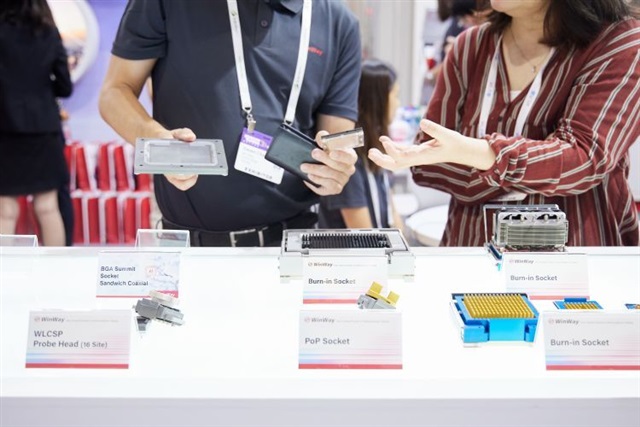
It’s neither a foundry nor a chipmaker, but WinWay Technology’s record monthly revenue in June matters almost as much as a quarterly report from NVIDIA. The Taiwanese company is a key supplier of advanced semiconductor test sockets and interfaces, and a surge in orders for complete AI test systems reveals a lot about the state of the production pipeline. According to DIGITIMES, June brought the highest monthly revenue in WinWay’s history, driven unmistakably by full AI test interface orders—the platforms used to validate GPUs, accelerators, and other processors destined for data centers and computing infrastructure.
Anyone planning on-premises deployments of Large Language Models should read the news with a critical eye. The availability of silicon for inference and training depends not only on the manufacturing capacity of TSMC or Samsung, but also on a frequently overlooked step: final test. AI chips, with their complex interposers, stacked HBM memory, and power envelopes approaching 700 W, require test sockets and interfaces capable of handling high currents and high-frequency signals without introducing noise or intermittent contacts. A bottleneck at this stage means longer lead times, higher scrap rates, and, ultimately, fewer available GPUs—or GPUs that reach the racks with lower reliability margins.
The boom in orders reported by WinWay suggests that the supply chain is strengthening precisely this link. It’s not an isolated signal: other back-end equipment suppliers, such as handler and tester manufacturers, have seen sustained demand over the past year. But WinWay’s data stands out because the company specializes in high-performance interfaces—the kind needed for multi-die packages and the high-coverage testing required by server-bound chips. In practice, ordering a “full” test system means someone is setting up production test lines for significant volumes.
For those weighing whether to invest in on-prem clusters or remain on the cloud, thinking about the quality and timing of hardware arriving in the coming quarters is critical. A jump in test capacity can speed up deliveries of next-generation GPUs—think successors to the H100 or inference-specialized models—and reduce the risk of defective units in early batches. On the other hand, if testing demand grows faster than installed capacity, chip vendors might have to choose between favoring large hyperscalers or also serving smaller enterprise customers. WinWay’s record, while no guarantee, hints at a determined response from the upstream ecosystem.
There is also a less obvious angle tied to data sovereignty. Regulated organizations pushing for self-hosted infrastructure need more than just GPUs; they need GPUs that can be verified and maintained under certified procedures. Robust testing shortens the time to bring new hardware into production, lowers TCO by cutting returns, and extends the operational life of components. In this light, expanding test capacity is a building block of the short, reliable supply chain that makes fully on-premises deployment feasible without sacrificing service continuity.
This isn’t a story that lands on a CFO’s desk, but it should. Because every euro spent on precision test sockets is a euro that helps make AI compute procurement more predictable.







💬 Comments (0)
🔒 Log in or register to comment on articles.
No comments yet. Be the first to comment!