
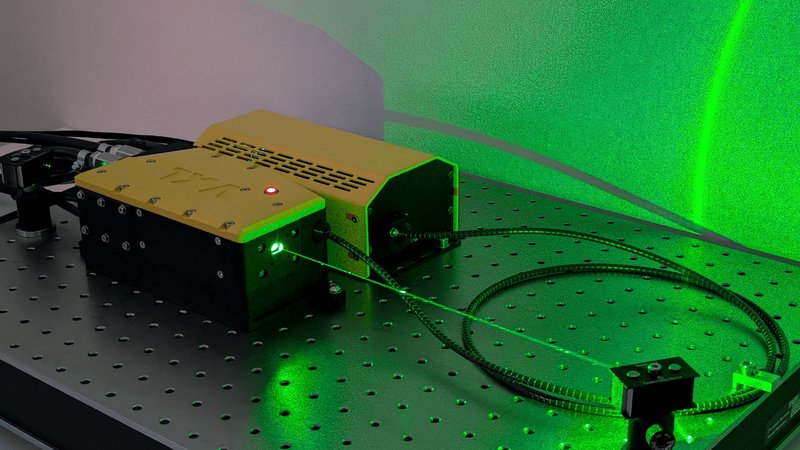
It might seem like a niche announcement, but it actually captures a structural shift: electrical connections inside datacenters are no longer enough. WST, a company still relatively unknown outside the optical supply chain, has stated it will begin shipping high-power continuous-wave (CW) lasers in Q4 2026, with a clear goal: to tap into the bandwidth hunger of the AI sector.
For those training or running inference on Large Language Models, the bottleneck has shifted from raw compute power to the ability to move data quickly. Copper-based links, even in their most advanced forms, are hitting physical limits over short distances inside ultra-dense GPU racks. The answer is integrated optics, with ever-faster transceiver modules and, upstream, continuous-wave laser sources that provide clean, stable signals for modulation.
The timing is no coincidence. Architectures for distributed training – think NVIDIA pods with thousands of GPUs – demand low-latency, highly reliable interconnects. A faulty or noisy CW laser can degrade the entire optical ring, making component quality critical. WST enters precisely there: it builds emitters that must stay lit for years, with minimal tolerance, under extreme thermal conditions.
For technical leads evaluating on-premise or air-gapped deployments, the announcement is more concrete than it appears. When designing a private cluster – perhaps for data sovereignty or to avoid the variable costs of the cloud – the choice of optical networking is not secondary. Having alternative suppliers of stabilized lasers reduces dependency on a few players, helps control costs, and allows greater customization. It’s the same pattern we’ve seen with HBM memory and InfiniBand networking: AI demand pushes components to specialize, creating a parallel value chain.
Then there’s the energy aspect. A well-designed optical link consumes less power than an equivalent electrical link over comparable reaches, and in a datacenter that can draw tens of megawatts, even a few watts saved per channel add up. WST has not released exact specifications, but the emphasis on high power suggests a design aimed at rack-row scale reaches, with enough margin to withstand long-term degradation.
The announcement also shines a light on the timeline: Q4 2026 is far enough out to allow orderly integration, but close enough to worry those who are locking in specifications for the next infrastructure refresh. Enterprises and labs planning datacenters with 18–24-month delivery windows will need to assess whether and how to incorporate WST’s offering. Meanwhile, the large optical module vendors – from Coherent to Lumentum – will be watching, aware that the AI segment is generating higher margins than traditional datacenters.
It’s not a revolution, but a cog. And it’s the kind of cog that, multiplied by thousands of lasers per datacenter, determines whether an architecture scales or not. For those tracking total cost of ownership, the entry of third-party players signals a maturing optical market for artificial intelligence: more competition, more choice, more pressure to standardize. And in hardware, standardization lowers TCO and makes self-hosting less risky.







💬 Comments (0)
🔒 Log in or register to comment on articles.
No comments yet. Be the first to comment!