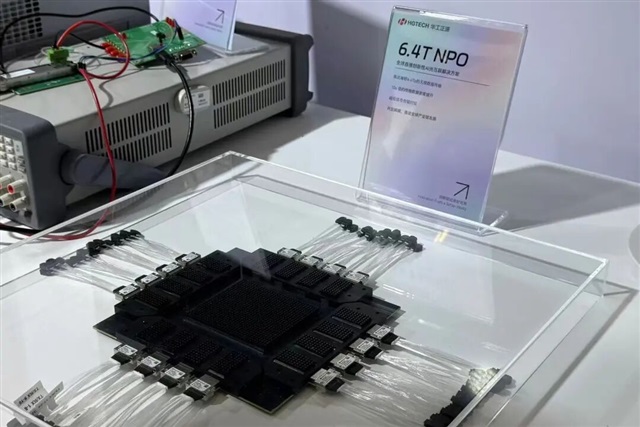
Wuhan Optics Hub Strengthens its AI Commitment
Wuhan's optics hub in China is positioning itself as a key player in the development of artificial intelligence infrastructure, as demonstrated by the recent debut of a 12.8 Tbps optical module. This initiative, involving Huagong Tech, underscores the region's strategic commitment to supporting AI growth through the development of fundamental hardware components.
Investment in advanced optical technologies is crucial for building high-performance data centers and computing clusters, which are indispensable for training and inference of Large Language Models (LLMs). The ability to manage enormous data volumes at high speeds is a prerequisite for the efficiency and scalability of modern AI applications, making modules like the one presented in Wuhan an enabling element for innovation in the sector.
The Importance of 12.8 Tbps Optical Modules for AI
A 12.8 Tbps optical module represents a significant milestone for AI infrastructure. These components are at the heart of high-speed interconnects within data centers, allowing GPUs and other AI accelerators to communicate with each other with unprecedented throughput. For LLM workloads, where the transfer of large amounts of data between computing nodes is constant, network latency and bandwidth are critical factors that directly impact performance and overall TCO.
The ability of a module to transfer data at 12.8 Terabits per second is essential to avoid bottlenecks in distributed training pipelines and large-scale inference. This is particularly true for on-premise deployments, where companies seek to maximize the efficiency of proprietary hardware. The adoption of advanced optical technologies ensures that investment in state-of-the-art GPUs is not undermined by an undersized network, offering the scalability needed to handle increasingly complex models and voluminous datasets.
Strategic Context and Implications for On-Premise Deployments
The development of high-speed optical modules in domestic contexts, such as Wuhan, reflects a global trend towards technological sovereignty and reducing reliance on foreign suppliers. For CTOs, DevOps leads, and infrastructure architects, the availability of locally developed hardware components can translate into greater supply chain control, better compliance with data sovereignty regulations, and potentially a more predictable TCO in the long term for self-hosted deployments.
The choice between cloud and on-premise solutions for AI workloads is often influenced by factors such as data security, customization needs, and direct control over hardware. Modules like Huagong Tech's are fundamental for building robust and competitive on-premise infrastructures capable of handling the training and inference demands of the most demanding LLMs. For those evaluating on-premise deployments, AI-RADAR offers analytical frameworks on /llm-onpremise to assess trade-offs between control, performance, and costs, highlighting how the quality of interconnects is a decisive factor.
Future Prospects for AI Infrastructure
Innovation in high-speed optical modules is a key indicator of the maturity and future direction of AI infrastructure. As Large Language Models become larger and more complex, and processing demands increase, the ability to efficiently and rapidly move data between computing components will become even more critical. This development in Wuhan, with the support of Huagong Tech, highlights a continuous commitment to building the necessary hardware foundations to support the next generation of AI applications.
The availability of such technologies not only strengthens a region's ability to compete in the global AI landscape but also provides companies opting for self-hosted solutions with the tools needed to build resilient, high-performing infrastructures that comply with their specific requirements. The evolution of these components is an enabling factor for innovation, ensuring that hardware can keep pace with the exponential advancements in AI software.







💬 Comments (0)
🔒 Log in or register to comment on articles.
No comments yet. Be the first to comment!