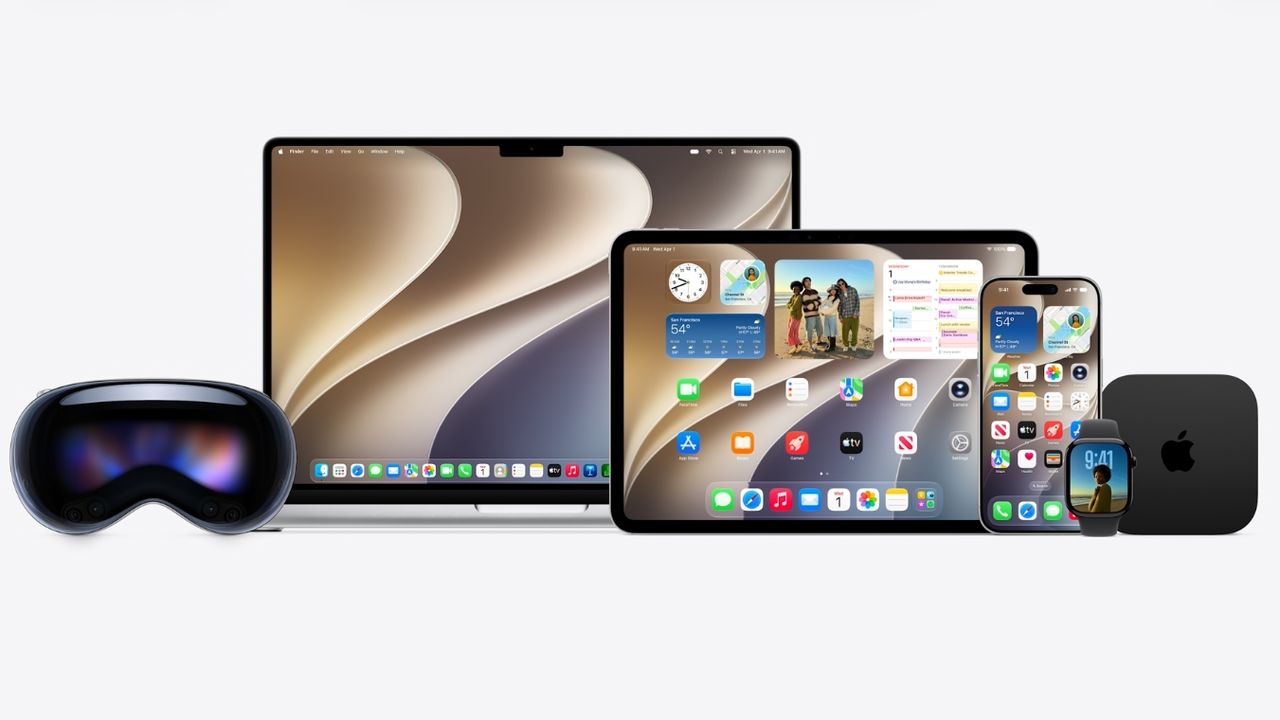
Apple Redefines AI Experience with Siri and macOS 27
During the recent Worldwide Developers Conference (WWDC), Apple presented a series of strategic updates aimed at consolidating its vision for artificial intelligence. Central to these innovations is a significant enhancement of Siri, designed to operate more integrally and performantly across the company's entire product ecosystem. These developments were previewed with macOS 27, dubbed "Golden Gate," highlighting Apple's commitment to bringing advanced AI capabilities directly to users' devices.
The announcement underscores a clear direction towards a more fluid and contextual user experience, where the voice assistant is no longer an isolated entity but an integral part of a unified AI strategy. This cross-platform approach is crucial for ensuring that intelligent functionalities are accessible and consistent, regardless of the device used, from Mac to iPhone.
"Liquid Glass" and Deep AI Integration
Among the innovations presented, improvements related to a technology called "Liquid Glass" stand out. While specific details are yet to be fully disclosed, the term suggests an extremely fluid, dynamic, and responsive user interface, capable of adapting in real-time to user interactions and the operating context. In the AI landscape, similar concepts can refer to systems that offer adaptive data visualization, predictive animations, or intelligent management of graphical resources for a "seamless" perceived experience.
Integrating these capabilities at the operating system level, as in macOS 27 Golden Gate, poses significant challenges in terms of hardware and software optimization. It requires careful management of computational resources, particularly for executing complex AI models directly on the device. This is a critical aspect for companies evaluating the deployment of Large Language Models (LLM) or other AI workloads on-premise, where managing VRAM, throughput, and latency is fundamental to ensuring adequate performance.
Implications for a Unified AI Strategy
Apple's emphasis on a "unified AI strategy" reflects a broader trend in the technology sector: the need to harmonize different artificial intelligence applications within a single, coherent vision. For businesses, this often translates into creating standardized AI pipelines, adopting common frameworks, and centralizing model management. The goal is to maximize efficiency, reduce redundancy, and ensure that data and inferences are handled securely and compliantly.
For organizations exploring the adoption of LLMs and other AI technologies, the choice between cloud and self-hosted deployment becomes a decisive factor. While cloud solutions offer scalability and flexible operational costs, on-premise implementations provide greater control over data sovereignty, compliance, and security—crucial aspects for regulated industries or air-gapped environments. The ability to run AI workloads on bare metal hardware, optimizing the use of GPUs with high VRAM, can offer significant advantages in terms of TCO and performance for specific workloads.
Future Prospects and AI Deployment Challenges
The evolution of AI capabilities, such as those demonstrated by Apple, highlights the increasing complexity in managing and deploying these technologies. For enterprises, the challenge is not just choosing the right model or framework, but also building the underlying infrastructure that can support intensive workloads efficiently and securely. This includes selecting appropriate hardware, configuring high-speed networks, and implementing quantization strategies to optimize memory usage.
AI-RADAR focuses precisely on these strategic decisions, providing analysis on the trade-offs between on-premise and cloud deployment for LLM workloads. Evaluating the Total Cost of Ownership (TCO), managing data sovereignty, and the need for concrete hardware specifications (such as GPU VRAM) are key elements for CTOs and infrastructure architects. Apple's announcement, while consumer-oriented, reflects the general push towards more pervasive AI, a trend that businesses must address with well-considered deployment strategies.









💬 Comments (0)
🔒 Log in or register to comment on articles.
No comments yet. Be the first to comment!