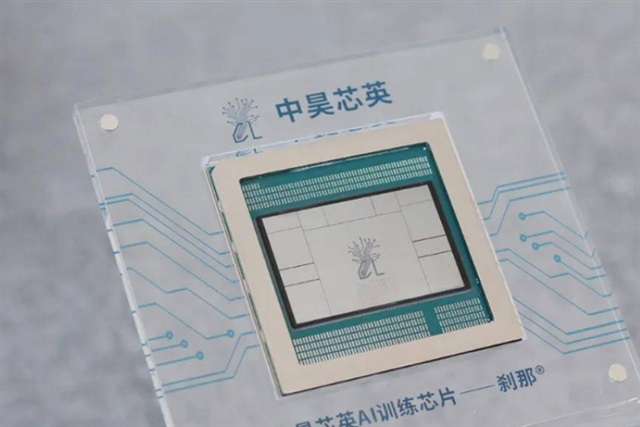
This isn’t just another AI chip. When a Chinese player like Zhonghao Xinying names its new TPU processor Xuyu, the accelerator landscape for LLMs and compute-intensive workloads gains a piece that matters beyond the spec sheet. The company, known among industry insiders for tensor processing unit manufacturing, has officially launched its latest processor with a clear goal: challenge GPU dominance in data centers and inference infrastructure.
The core of the challenge lies in the architecture itself. Unlike GPUs, TPUs are purpose-built for tensor operations without the baggage of graphics rendering. In theory, this means higher computational density and lower power consumption for specific workloads — from field inference to fine-tuning language models, increasingly handled in self-hosted environments. While NVIDIA dominates with its GPUs and CUDA software, the arrival of new specialized silicon rebalances the debate on which platform is best for running LLMs without cloud dependencies.
Beyond technical rivalry
Zhonghao Xinying’s move is more than an engineering play. Geopolitical pressures are driving companies and governments to rethink semiconductor supply chains. A processor entirely developed in China, targeting AI accelerators, speaks directly to the issue of technological sovereignty. For organizations managing sensitive data and strict compliance rules — from healthcare to public administration — the availability of hardware not subject to export controls can become a decisive factor in on-premise deployment decisions. AI-RADAR has long tracked the evolution of local stacks, and the entry of new chip families makes the picture even more fluid for those evaluating the Total Cost of Ownership of private infrastructure.
What changes for on-premise evaluators
The key hurdle remains ecosystem maturity. NVIDIA’s strength isn’t just raw performance, but near-universal software compatibility: frameworks like PyTorch and TensorFlow, serving pipelines with vLLM or TensorRT-LLM, optimized libraries for INT8 or FP16 quantization. Every new accelerator has to carve out a place in this stack, offering compilation tools and runtimes that win over seasoned development teams. The Xuyu announcement doesn’t yet address these fronts, but the direction is clear: competition will push toward greater hardware modularity for LLMs, a boon for those seeking alternatives to classic GPU clusters and aiming to avoid vendor lock-in.
At the same time, the idea that the future of AI compute won’t be monolithic gains traction. The coexistence of TPUs, GPUs, FPGAs, and hybrid solutions is already a reality in many serving architectures. A chip like Xuyu could find a place precisely in scenarios where per-token efficiency and consistent latency matter more than absolute flexibility. It’s not an overnight revolution, but an evolution that reshapes plans for enterprise-scale LLM deployments, making it essential to keep a close eye on new accelerator market entries.
Zhonghao Xinying hasn’t released benchmarks or VRAM specs. Yet the mere fact that a Chinese TPU is presented as a GPU alternative sends a signal to the entire sector: the AI hardware game will increasingly be fought on the grounds of efficiency and technological autonomy — two variables that anyone managing on-premise resources can no longer afford to ignore.






💬 Comments (0)
🔒 Log in or register to comment on articles.
No comments yet. Be the first to comment!