Topic / Trend Rising

Optimized Local LLM Inference

Open-source runtimes and techniques are making local LLM deployment faster and cheaper. llama.cpp CPU boosts, GGUF-native Transformers, vLLM hardware-agnostic layers, OpenVINO, Vulkan/ZLUDA and sparse attention/quantization all reduce the cost of self-hosted inference.

Detected: 2026-09-27 ยท Updated: 2026-09-27

Related Coverage

2026-09-27 โ€ข LocalLLaMA

llama.cpp speeds up prompt lookup drafting by 42 times

The open-source runtime for local LLM inference brings a change that makes prompt lookup drafting 42 times faster. This is not full generation speed, but a key component of speculative decoding: for self-hosted deployments, it can cut overhead and TC...

#Hardware #LLM On-Premise #DevOps

2026-09-26 โ€ข LocalLLaMA

llama.cpp speeds up CPU prompt processing with tiled mul_mat for k-quants

A pull request in llama.cpp introduces a tiled matrix-vector multiplication for k-quant formats. According to the report, using VNNI instructions speeds up CPU mul_mat by 3-7x with minimal added complexity. The improvement targets prompt prefill, mak...

#Hardware #LLM On-Premise #Fine-Tuning
2026-09-26 โ€ข LocalLLaMA

Custom Models in Oh My Pi: vLLM, llama.cpp, SGLang and More

A sparse Reddit note points to Oh My Pi and custom model support through vLLM, llama.cpp, and SGLang. The real story is structural: self-hosted inference still depends on multiple runtimes with distinct hardware profiles, and integrationโ€”not a single...

#Hardware #LLM On-Premise #DevOps

2026-09-25 โ€ข LocalLLaMA

Qwengram-0.8B: external n-gram memory cuts perplexity by 5.05%

An experiment keeps Qwen3.5-0.8B frozen, adds a 51-billion-parameter PLE memory and an R=1 reader: validation perplexity drops by 5.05%. The author warns this is not benchmark accuracy gain and releases GGUFs, a modified llama.cpp runtime, and a quan...

#Hardware #LLM On-Premise #Fine-Tuning
2026-09-23 โ€ข LocalLLaMA

Native GGUF support in Transformers: what it means for local deployment

Hugging Face has added native GGUF support to Transformers. Users can load a quantized model by specifying the file path and use standard APIs. On supported Apple Silicon, ggml kernels are reused, with M2 Max benchmarks close to llama.cpp. The goal i...

#Hardware #LLM On-Premise #DevOps

2026-09-22 โ€ข PyTorch Blog

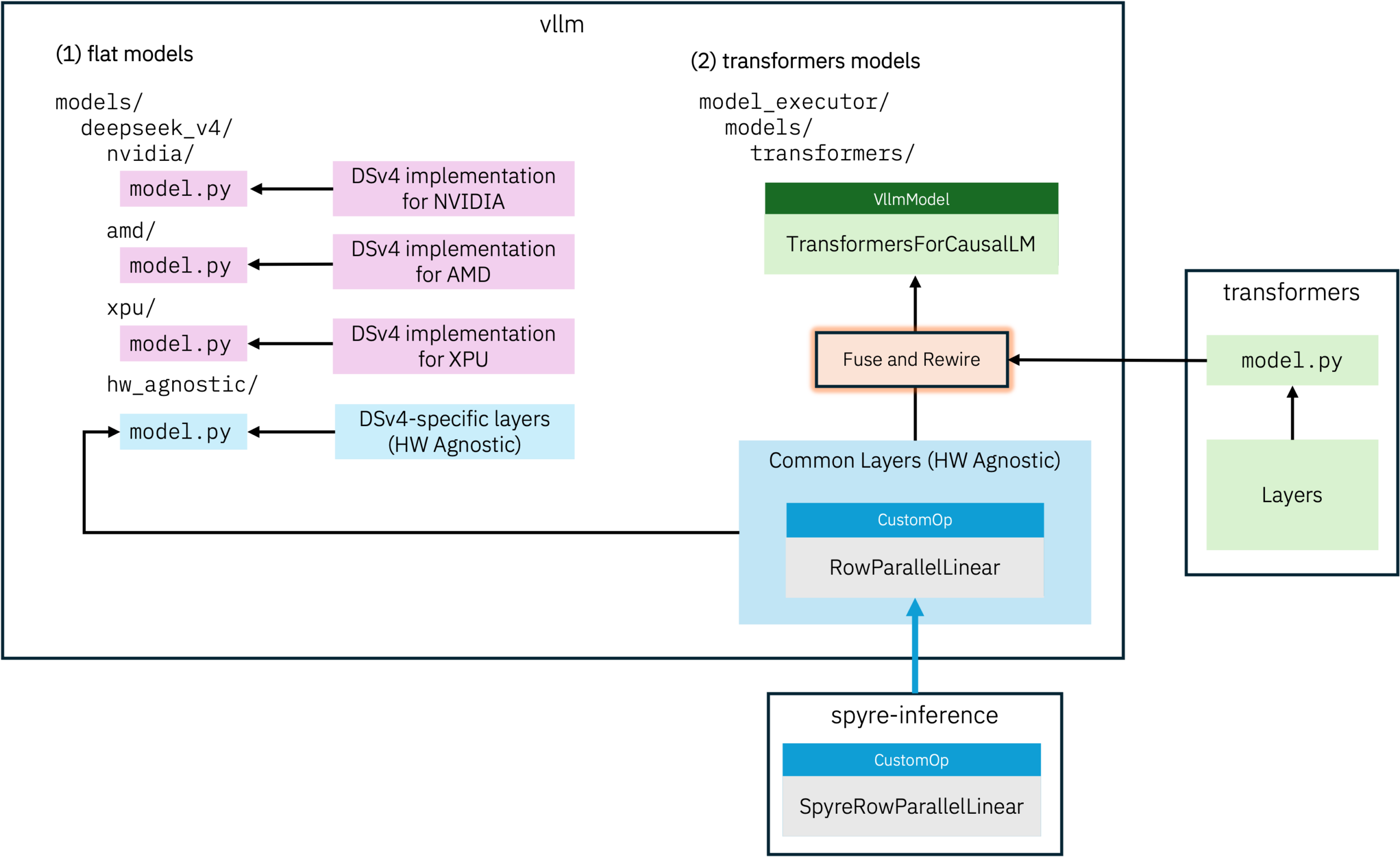
vLLM splits paths: hardware-agnostic layers keep portability alive

vLLM is introducing in-tree hardware-agnostic layers to keep supporting out-of-tree accelerators, older datacenter GPUs, and consumer cards. On NVIDIA H100, total token throughput stays within 3.4% of the native implementation. The move separates fla...

#Hardware #LLM On-Premise #DevOps

2026-09-22 โ€ข Phoronix

ZLUDA Now Supports Some NVIDIA cuFFT APIs via hipFFT

The open-source ZLUDA project has added support for some NVIDIA cuFFT APIs by relying on hipFFT, part of AMD's ROCm/HIP stack. The move broadens CUDA compatibility on non-NVIDIA GPUs such as Radeon and signals a strategic shift in the portability eco...

#Hardware #LLM On-Premise #DevOps
2026-09-22 โ€ข ArXiv cs.LG

PRQuant: static residual quantization for low-overhead inference

PRQuant combines channel reorganization and static residual compensation to reduce inference overhead in low-bit quantization. The method is training-free, builds contiguous tail blocks offline, and avoids dynamic online gathering by turning scattere...

#Hardware #LLM On-Premise #Fine-Tuning
2026-09-21 โ€ข ArXiv cs.AI

RBS-Attention: training-free sparse prefill for long-context LLMs

A training-free method reduces prefill cost in long-context LLMs by targeting 'mean dilution', where a block centroid hides relevant tokens. RBS-Attention combines a centroid-based branch with a rescue branch based on maximum key-block radius. On H10...

#Hardware #LLM On-Premise #Fine-Tuning
โ† Back to All Topics