
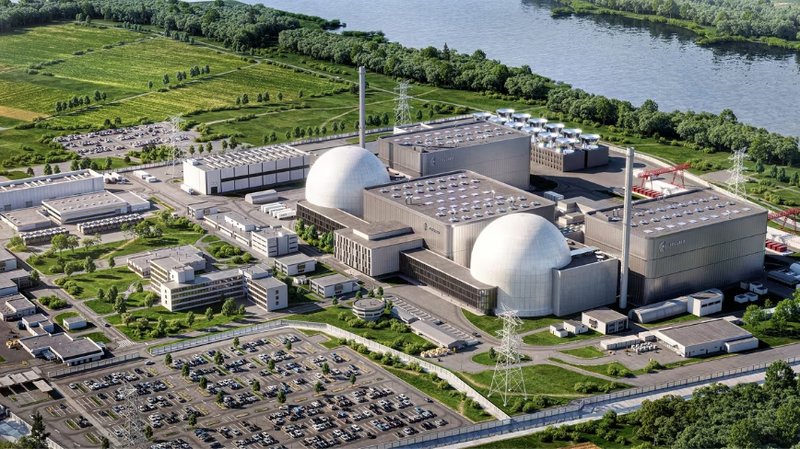
The news comes from TechRadar: Polish billionaire Michał Sołowow, via his holding company SGE, plans to install 14 small nuclear reactors in the United Kingdom. These are GE Vernova Hitachi's BWRX-300 models, each with a capacity of about 300 MWe. Estimated investment is £35 billion, with first power targeted for 2034.
The narrative centers on decarbonisation and national energy security. Yet behind these numbers lies a structural shift that reaches far beyond traditional power generation. The reactor geography – three sites spread across the territory – and their small size point to a deliberate direction: distributed, resilient, modular generation. This is exactly what operators of intensive compute infrastructure, far from centralised cloud hubs, require.
Why on-premise AI craves stable power
Workloads linked to Large Language Models (LLMs) – from inference to training – consume energy in an intermittent but intense manner. An on-premise cluster dedicated to fine-tuning models with tens of billions of parameters can draw hundreds of kilowatts for hours, stressing already fragile grids. The real bottleneck is not just the availability of GPUs with sufficient VRAM, but the ability to power them without interruption and at predictable costs.
Sołowow's approach opens a concrete scenario: energy-self-sufficient data centers, possibly co-located with mini reactors, capable of operating independently of wholesale electricity price fluctuations. In a data sovereignty context – where banks, defence, and public administration evaluate self-hosted deployments for regulatory reasons – dedicated energy availability reduces operational risk and long-term Total Cost of Ownership (TCO).
Who wins and who loses
On-premise solution providers and integrators designing air-gapped environments stand to gain. Having a modular, programmable electricity supply allows for more aggressive hardware sizing without compromising operational continuity. Chip makers also benefit indirectly: if the energy bottleneck eases, more GPUs can be saturated in a single site, increasing compute density.
Conversely, large cloud providers – which built their competitive edge on hyperscale data center efficiency powered by often opaque energy mixes – could see their cost differential erode. Distributed nuclear energy blurs the line between the assumed efficiency of the cloud and the reality of on-premise consumption, pushing organisations to recalculate their TCO by including independence and control parameters.
The structural signal
More than a single industrial project, the UK initiative signals that the next wave of AI investment will travel through redefined physical infrastructure. It is no longer enough to discuss quantization or serving pipelines; the energy substrate must be considered an integral part of deployment architecture. Models become critical assets, and their availability depends on grid resilience as much as software quality.
The 2034 horizon may seem distant, but industrial data center planning cycles span decades. Those currently evaluating bringing LLMs on-premise – balancing orchestration frameworks, GDPR compliance, and inference costs – would do well to include energy source and stability in their decision matrix. Because a dedicated modular reactor could become the true enabler of a genuinely independent AI strategy.








💬 Comments (0)
🔒 Log in or register to comment on articles.
No comments yet. Be the first to comment!