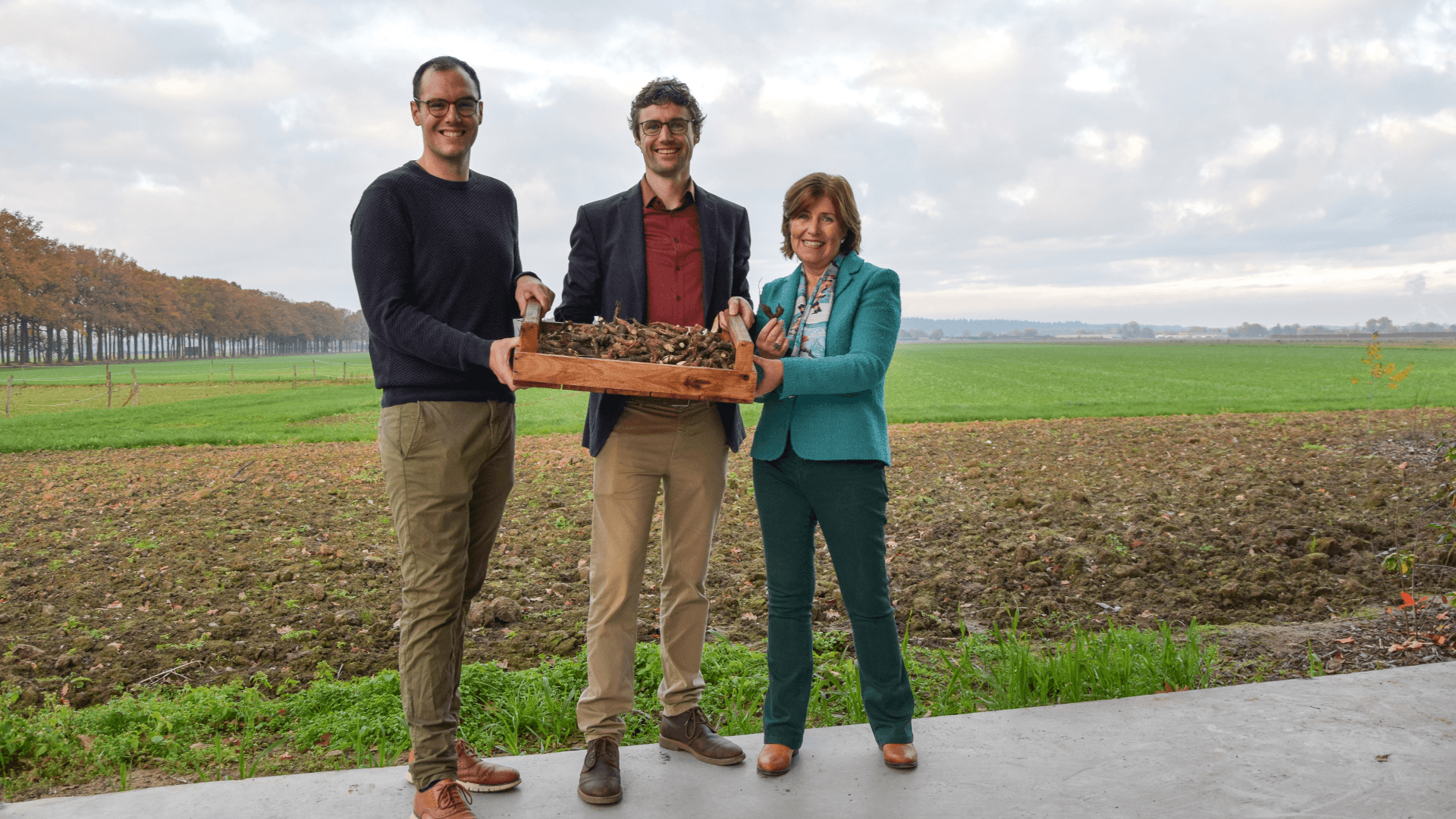
The seed of this story is not in the fields but in the server rooms. Aardaia, a Wageningen-based agritech startup, has just closed a €5 million seed round led by Point Nine, with participation from FoodLabs, Astanor, Grey Silo and a group of angel investors. Founded in 2025 by Pádraic Flood and Mike Henske, the company is developing a breeding platform that identifies and domesticates wild plant species to create new crops without genetic modification or gene editing. Its first product is the aardaker, a protein-rich tuber that promises the productivity of a root crop combined with the nitrogen-fixing ability of legumes, eliminating the need for synthetic fertiliser and reducing reliance on imported protein sources.
Behind this green narrative hides a computational engine few agritech stories bring into focus. Aardaia says it expects to screen around 750,000 unique aardaker genotypes this year, with the aim of reaching two million thanks to the new funding. To put that in perspective: each genotype requires whole-genome sequencing, phenotyping and predictive modelling through computational biology. This is not a hoe-and-greenhouse problem, but a data pipeline crunching terabytes of raw information that demands serious compute architecture. The platform promises to evaluate more varieties in far shorter timeframes than conventional methods, yet the real bottleneck has become hardware: processing units capable of running genome alignments, simulations and large-scale statistical inference, often GPU-accelerated and backed by high-performance storage.
For those who follow on-premise deployment choices, Aardaia’s case is a signal. Companies handling proprietary genetic material tend to avoid the public cloud for reasons of data sovereignty and intellectual property protection. Genomes are not just bits; they encapsulate a cultivar’s competitive edge, and a data leak could wipe out years of research. This pushes toward local clusters, bare metal and self-hosted infrastructure, where access control is total and network latency does not throttle rapid algorithmic iteration. We don’t know which stack Aardaia uses, but the parallel with LLM workloads is striking: large data volumes, need for fast memory, processing chains reminiscent of training and inference pipelines. The difference lies in the output: instead of a text completion, you get a phenotypic prediction that guides the next cross.
There is a deeper, almost structural thesis. Precision agriculture is becoming a computational discipline as much as language model development. Aardaia’s investment fuels not only greenhouses and gene banks but also, and above all, compute power, data engineers and simulation frameworks. If this trend consolidates, demand for specialised hardware will no longer come solely from AI labs: genomic breeding centres will become significant buyers of multi-GPU servers, NVMe storage and low-latency networking. For on-prem infrastructure providers, this means a market expansion beyond the classic AI data centre perimeter.
In the short term, the winners will be large silicon vendors and system integrators able to assemble HPC nodes for bioinformatics workloads. Traditional agritech companies, still tied to purely visual phenotypic selection and lacking the necessary scale, could lose out. But the most interesting signal concerns food sovereignty: if advanced breeding platforms remain the preserve of a few hyper-computational labs, control over crop diversity might become even more concentrated. The aardaker is a first concrete step; the real harvest will be measured in exaflops. For those evaluating on-premise deployment in similar domains, trade-offs between TCO, scalability and compliance exist—areas that AI-RADAR explores in its analytical frameworks.
“For most of history, inventing a new crop took millennia,” said co-founder and CEO Pádraic Flood. “We can now design crops on demand, drawing on hundreds of millions of years of evolution to find plants that are already built to win. The aardaker is our first, and this round lets us put our foot on the accelerator.” The accelerator metaphor is apt: breeding speed is now measured in compute cycles, and Aardaia has just stepped on the gas.





💬 Comments (0)
🔒 Log in or register to comment on articles.
No comments yet. Be the first to comment!