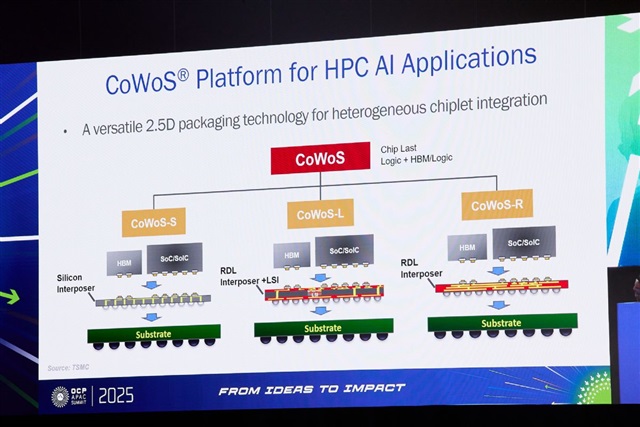
Behind every GPU or AI accelerator powering Large Language Models sits a sheet of resin you can’t see, yet without it the chip won’t work. It’s the ABF (Ajinomoto Build-up Film) substrate, a dielectric film that enables high-density interconnection between silicon and the rest of the system, essential for packaging processors like NVIDIA’s H100, AMD’s MI300X, or the custom chips from major cloud providers.
The explosion in AI demand has tipped that market into shortage, and DIGITIMES sources indicate the pressure will not ease until at least 2028. The root cause is a mix of chemistry and investment: ABF production is concentrated in a handful of players (mostly Japanese), requires dedicated lines with long build times, and offers margins that only become viable at high volumes. The AI boom has consumed available capacity faster than suppliers can expand it, and while substrate makers are racing to add new lines, each one takes years to qualify and ramp.
The beneficiaries of this bottleneck are the cloud giants. Microsoft, Amazon, and Google wield contractual muscle and multi-year agreements that put them at the front of the delivery queue; they can absorb price hikes and place orders far in advance. Their data centers will keep absorbing GPUs, reinforcing a centralized model for inference and training. For organizations evaluating on-premise deployment, however, the equation changes: procurement lead times stretch, accelerator prices climb, and the window for building private clusters becomes far less predictable. Those with strict data sovereignty or low-latency requirements—banks, defense, healthcare, sensitive manufacturing—risk being caught in a limbo where self-hosted AI is technically attractive but logistically punishing.
Structurally, the ABF shortage highlights a growing asymmetry: the physical infrastructure of AI is far less elastic than the software running on it. Models can be downloaded, quantized, and optimized overnight; packaging fabs cannot. This directly affects Total Cost of Ownership calculations: comparing cloud subscription fees against hardware amortization is no longer enough, because the true cost of on-premise today is the access to hardware itself. In effect, scarcity rewrites the time variable, forcing organizations to reserve capacity years ahead or fall back on hybrid setups that reintroduce data transfer and compliance constraints.
Over the medium term, the squeeze on ABF substrates may accelerate the shift to alternative packaging technologies, such as glass-core substrates or next-generation silicon interposers, where Intel and others are investing. But these too must navigate steep industrial learning curves and won’t be mature before the end of the decade. Meanwhile, the geographic concentration of production—Japan, Taiwan, South Korea—adds a layer of geopolitical risk to an already strained supply chain.
For anyone designing private LLM architectures today, the picture is straightforward: procurement planning must move beyond traditional quarterly cycles to a horizon of at least two years, with buffers for delays and price revisions. This is not a temporary bubble but a structural realignment that will separate those who can afford to wait from those who must move fast, and that in the interim may lend fresh momentum to software optimization techniques capable of squeezing more work out of hardware already in place.









💬 Comments (0)
🔒 Log in or register to comment on articles.
No comments yet. Be the first to comment!