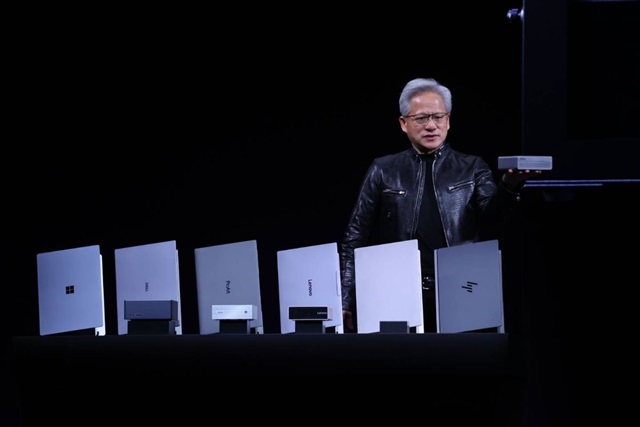
The Transforming Notebook Market: The Impact of AI PCs
The notebook sector is currently experiencing a period of uncertainty, characterized by subdued demand. In this context, the introduction of so-called "AI PCs" and the consistent presence of low-end MacBooks are redefining expectations and competitive dynamics. Although the overall market shows signs of weakness, attention is increasingly shifting towards local processing capabilities, particularly for artificial intelligence workloads.
This trend suggests a change in priorities for consumers and businesses, who are beginning to evaluate not only generic computing power but also the efficiency and specific performance for executing AI models directly on the device. The ability to perform local Inference, without constant reliance on cloud resources, emerges as a distinguishing factor.
Local Inference: A Key Factor for AI PCs
AI PCs are distinguished by the integration of dedicated hardware, such as Neural Processing Units (NPUs), designed to accelerate artificial intelligence workloads. This architecture allows complex tasks, such as processing smaller Large Language Models (LLMs) or real-time data analysis, to be executed directly on the device. The primary advantage lies in reduced latency and the ability to operate even in air-gapped environments or with limited connectivity.
The possibility of performing local Inference opens new perspectives for companies that need to process sensitive data or ensure data sovereignty. Instead of sending data to external cloud services, AI operations can remain within the company's perimeter or on the user's device, strengthening compliance and security. This approach aligns with on-premise and hybrid deployment needs, offering a valid alternative to purely cloud-based models.
Data Sovereignty and TCO: Strategic Implications
The adoption of AI PCs with local Inference capabilities has significant repercussions on data sovereignty and Total Cost of Ownership (TCO). Keeping AI processing local means having more direct control over data, a crucial aspect for regulated sectors or companies with stringent privacy requirements, such as those imposed by GDPR. This reduces the risk associated with transferring and storing data on third-party infrastructures.
From a TCO perspective, although the initial hardware investment may be higher, the reduction in operational costs related to using cloud resources (pay-per-use) can generate long-term savings for specific workloads. The evaluation between CapEx (investment in local hardware) and OpEx (recurring cloud costs) thus becomes a fundamental strategic exercise. For those evaluating on-premise deployment, AI-RADAR offers analytical frameworks on /llm-onpremise to assess these trade-offs, considering factors such as VRAM, throughput, and infrastructure requirements.
Future Prospects: Towards a Distributed AI Ecosystem
The emergence of AI PCs and their influence on the notebook market indicate a clear direction towards a more distributed AI ecosystem. No longer confined exclusively to data centers or the cloud, artificial intelligence is migrating towards the edge and end devices. This evolution requires companies to rethink their development and deployment pipelines, considering hybrid architectures that balance cloud power with the agility and security of local processing.
The ability to perform Fine-tuning or Inference on local hardware, even with smaller models, represents an important step towards greater autonomy and resilience. Decisions regarding hardware, VRAM management, and model optimization for execution on resource-constrained devices will become increasingly central for CTOs and infrastructure architects aiming to build robust and compliant AI solutions.







💬 Comments (0)
🔒 Log in or register to comment on articles.
No comments yet. Be the first to comment!