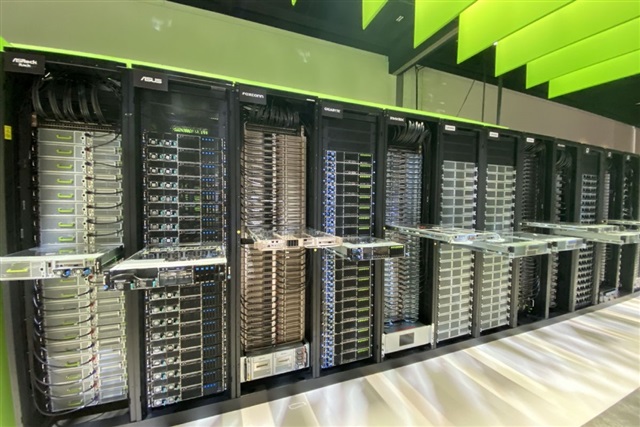
A newly published Digitimes investigation on AI servers sheds light on a pivotal shift for the entire tech supply chain: Taiwan’s motherboard industry, historically dominant in the consumer and gaming markets, is redefining its DNA around Large Language Model workloads. This is more than industry news — for those designing on-premise infrastructure, the transition carries weight beyond journalistic curiosity.
Companies we've come to know for high-performance gaming motherboards — Gigabyte, Asus, ASRock, MSI — have long operated dedicated enterprise divisions alongside their consumer lines. Today, the difference lies in scale and specialization. Manufacturing is increasingly oriented toward barebone servers and custom platforms for GPU accelerators, with obsessive attention to power delivery, cooling, and compute density. In a local inference context, these factors translate into lower latency and the ability to handle progressively larger models.
Why the motherboard matters for on-premise deployment
The choice of a server platform is often dominated by the chip and available VRAM, but the substrate on which these components rest — circuit design, bus topology, firmware — determines how efficiently a system can scale. Taiwanese manufacturers have accumulated decades of high-speed PCB design know-how and are now pouring it into multi-GPU configurations tailored for LLM training and inference. This lowers the barrier for organizations wanting to keep data on-site, avoiding recurring cloud fees and reducing TCO over extended time horizons.
More than just hardware, the maturation of these platforms intersects with growing demand for digital sovereignty. Banks, healthcare, public administration, and industrial entities bound by GDPR require validated, maintainable infrastructure with predictable lifecycles. Motherboard makers entering this space broaden the supply, increasing competitive pressure and potentially reducing the cost of entry for local processing.
The supply chain node
The evolution recounted by the report also exposes a raw nerve: global supply chain reliance on a concentrated manufacturing ecosystem. Taiwan remains an irreplaceable hub for motherboards and servers, and the AI pivot only heightens this geostrategic criticality. For on-premise deployment, this means planning procurement and maintenance well in advance, since any bottlenecks on specialized components (VRAM, interposers, cooling systems) directly affect machine availability.
In this landscape, analytical tools like those offered by AI-RADAR on /llm-onpremise enable modeling trade-offs between cost, performance, and infrastructure autonomy. The Digitimes investigation adds no new benchmarks, but it illuminates a deeper current that, for those architecting self-hosted systems, acts as a signal: the world’s leading motherboard forge is betting on AI servers, reshaping the map of available choices.





💬 Comments (0)
🔒 Log in or register to comment on articles.
No comments yet. Be the first to comment!