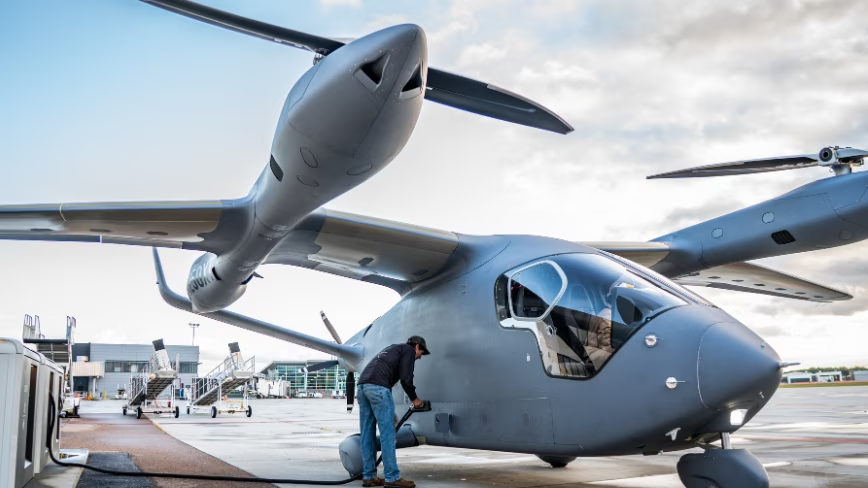
Beta Technologies, an Amazon-backed company, has completed the first flights under the US government's electric air-taxi pilot programme. According to CNBC, the inaugural missions did not carry passengers but instead transported laboratory-manufactured organs for United Therapeutics. The flights connected airports in Maryland and Virginia, covering approximately 275 nautical miles (just over 500 kilometres), using eVTOL aircraft — electric vertical takeoff and landing vehicles, the technology dozens of startups and aerospace giants are betting on for urban air mobility.
Choosing not to board people at this stage is prudent, but the most telling detail is not the biological cargo itself: it is the nature of the flight that raises profound questions for those working with artificial intelligence in the real world. Any unmanned aircraft, especially one designed to operate in congested airspace, must make split-second decisions: detect obstacles, optimise routing, manage emergencies. In such a setting, cloud latency is simply unacceptable. Inference — the moment an AI model processes sensor data and produces an action — must happen on board, on embedded hardware, in real time.
This constraint brings air taxis close to a class of problems well known to those evaluating on-premise deployments: when latency determines safety, data sovereignty becomes non-negotiable, and intermittent connectivity is the rule rather than the exception, running computation where data is generated is no longer one architectural choice among many. It is a functional necessity.
On the hardware side, autonomous aircraft impose strict size, weight, and power (SWaP) limits. Chips must consume little, dissipate heat in tight volumes, and offer enough throughput for models ranging from computer vision to sensor fusion. Techniques like quantization, which reduces the numerical precision of a neural network's weights to run models on less powerful accelerators, and fine-tuning for optimised architectures become the norm rather than the exception. It is familiar ground for those who today bring LLMs onto consumer GPUs or bare-metal servers in the enterprise, where every watt and every gigabyte of VRAM matters in the TCO.
Then there is the sovereignty chapter. Transporting organs for clinical use — even in a testing phase — introduces privacy and compliance considerations. If sensors collect data about the surrounding environment or the cargo's cold chain, those data may need to remain under local control for regulatory reasons (GDPR for healthcare loads in Europe, FDA or HIPAA rules in the US). An architecture that offloads everything to the cloud clashes with these constraints, whereas a local inference infrastructure, managed with secure update pipelines, offers stronger guarantees.
The news of Beta Technologies' first flights is, in itself, a step toward integrating eVTOLs into the transport system. But for engineers working on Large Language Models, serving frameworks, and hardware supply chains, it is also a reminder: the future of AI is not only in data centres, but on everything that flies, drives, or operates in extreme conditions. On-premise inference — or rather, on-edge inference — is not an indulgence; it is the prerequisite for bringing intelligence out of the server room and into the physical world.







💬 Comments (0)
🔒 Log in or register to comment on articles.
No comments yet. Be the first to comment!