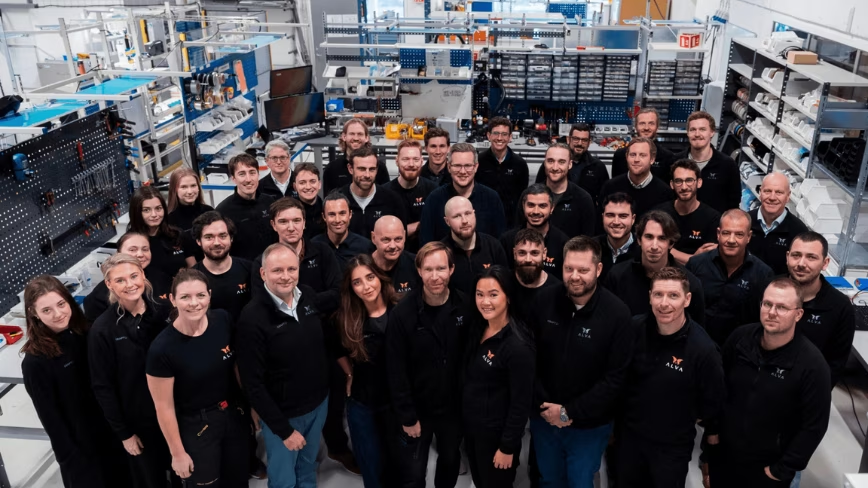
On July 2, Trondheim-based deep-tech company Alva Industries announced a €16 million funding round to accelerate production of its ultra-compact electric motors. The round is led by Nysnø Climate Investments, Sandwater, and Emerald Technology Ventures, the latter investing on behalf of the Nabtesco Technology Ventures fund, with participation from existing backers Statkraft Ventures and EnvisionTech.
These motors, designed for applications where space and weight are critical, do not only concern drones or light electric mobility. Those tracking embedded AI know that one of the bottlenecks in advanced robotics and edge computing is actuation: having compact, efficient motors that can run for long periods without heat dissipation allows building autonomous platforms capable of performing local inference without relying on expensive cloud connections.
From this perspective, funding a company like Alva signals a clear direction: scaling production to industrial volumes will lower unit costs and pave the way for on-premise deployment of robots and smart machines where data sovereignty and low latency are non-negotiable requirements. For applications in isolated industrial environments, automated warehouses, or critical infrastructure, running computer vision models or real-time control on local hardware becomes a competitive advantage, before even being a technical necessity.
From a Total Cost of Ownership standpoint, choosing fully self-hosted solutions reduces dependency on external providers and the recurring cost of data traffic. It's no coincidence that our AI-RADAR observatory closely tracks any development in the hardware supply chain that enables moving inference away from centralized data centers.
The participation of investors like Nysnø, focused on climate technologies, and a corporate venture like Emerald tied to Nabtesco—operating in industrial automation and precision components—suggests that the game is played on multiple tables: energy efficiency, emission reduction, and distributed automation. Alva's electric motors, while not AI chips, are a piece of the ecosystem that makes large-scale edge computing practical.







💬 Comments (0)
🔒 Log in or register to comment on articles.
No comments yet. Be the first to comment!