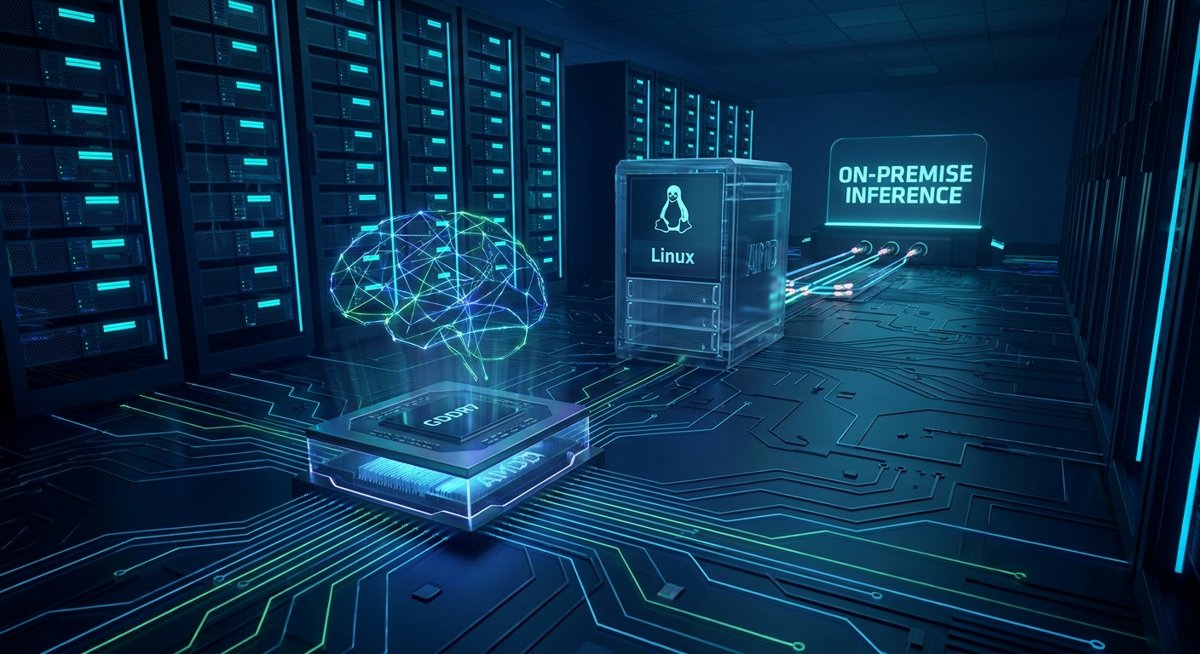
The driver before the silicon: a signal to read between the lines
When AMD starts adding GDDR7 support to its Linux GPU drivers, the market doesn't move much. Yet for those operating open-source GPU infrastructure, this news is worth more than many commercial announcements. Driver work precedes the arrival of cards and reveals a direction: the next generation of graphics memory is entering software before marketing. It's the classic signal you catch only by watching commits in repositories, not press releases.
The reason is structural. AMD's Linux drivers are open source and follow a transparent development cycle. When a vendor begins preparing support for a new memory technology, the work appears in changelogs and upstream patches weeks or months before hardware availability. For teams planning on-premise deployments, this head start is a concrete advantage: it allows them to assess software maturity and imagine upgrade cycles without waiting for closed binaries or official announcements.
The news itself doesn't move stock prices, but it shifts expectations. Those managing bare metal servers or nodes with repurposed consumer GPUs know that new hardware bring-up takes time and that the driver is often the bottleneck. The fact that AMD is already working on GDDR7 indicates the Linux ecosystem will see support earlier than in the proprietary driver world, reducing uncertainty for those evaluating future components.
Memory bandwidth and token generation: the bottleneck of LLM inference
To understand why GDDR7 matters for those running Large Language Model inference, you have to look at how token generation works. During this phase, the GPU must continuously move weights and cache between VRAM and compute units. If memory bandwidth can't keep pace, compute capacity remains partially idle and perceived latency grows. It's a known limit for those running models on-premise: having a powerful GPU isn't enough; the memory must also be fast enough to feed it.
GDDR7 promises higher bandwidth than previous generations. The source doesn't report numbers, but the point isn't to quantify the improvement—it's to recognize that the value of this evolution plays out precisely on the bandwidth front. For LLM inference workloads, where every generated token requires repeated access to model parameters, faster memory can translate into lower latencies and more efficient use of compute units.
This link between bandwidth and inference performance is evergreen: it holds today as it did for previous generations. What changes with GDDR7 is the prospect of bringing this benefit to consumer and professional platforms, where graphics memory is often the factor limiting the size of models that can run locally. For those building self-hosted machines, bandwidth isn't just a spec—it's the parameter that decides whether a model runs smoothly or the pipeline becomes unsustainable.
Self-hosted and Linux: why early support reduces friction
Most self-hosted inference machines, from bare metal servers to nodes with repurposed consumer GPUs, run on Linux. This isn't a random choice: Linux offers control, transparency, and the ability to maintain uniform software stacks. Early support in the open-source driver reduces friction for those integrating new hardware into existing pipelines, without waiting for proprietary binaries or vendor-specific tooling.
AMD's work on GDDR7 in Linux drivers touches a sensitive point: memory management. When a driver correctly recognizes a new memory generation, it avoids a range of problems from sudden crashes to unstable performance. For teams operating in production, this stability is critical. It's not about having cards tomorrow, but knowing that support will arrive incrementally and verifiably, with patches the community can test and improve.
Moreover, AMD's open-source approach allows maintaining uniform system images across multiple hardware generations. Those standardizing on Linux for control and data sovereignty reasons can update kernel and modules without adopting proprietary stacks. This shifts control toward infrastructure managers, reducing dependence on closed tooling and accelerating adoption of new hardware when it becomes available.
TCO and planning: reading kernel signals to evaluate future hardware
For those planning hardware for on-premise training or inference, Total Cost of Ownership isn't just about purchase price. It includes integration costs, debugging hours, downtime, and the useful life of the investment. A driver that arrives early and works well reduces many of these hidden costs. When AMD begins GDDR7 bring-up in Linux drivers, it gives teams an early signal about technological direction and support maturity.
Availability of support in the kernel or open modules doesn't eliminate compatibility risks, but it shifts control toward infrastructure managers. Instead of waiting for a vendor to release binary drivers with delayed features, teams can follow upstream development, test patches, and prepare their stacks. This changes the pace at which future components are evaluated and TCO forecasts are made: integration design can start before hardware hits the market.
Another relevant aspect is longevity. On-premise infrastructure tends to remain operational for years, spanning multiple hardware generations. A well-maintained open driver facilitates coexistence of old and new GPUs in the same fleet, avoiding the need to manage separate binaries or prematurely retire functional components. For those reasoning in TCO terms, this continuity is a concrete advantage.
Data sovereignty and independence from tooling: the non-commercial value
Companies and laboratories standardizing on Linux for control and data sovereignty reasons look at this news with interest. An open, updated driver reduces dependence on proprietary tooling and allows uniform system images across hardware generations. It's not just about costs—it's about operational control. Those managing sensitive data on-premise can't afford to depend on closed software that might change licensing or drop support.
Early GDDR7 support in AMD's Linux drivers strengthens this position. It means the open-source ecosystem will access new memory technologies without going through binary stacks or vendor agreements. For teams building self-hosted inference pipelines, this independence translates into lower risk and greater flexibility in hardware choices.
Conversely, cloud-only environments that don't want to manage custom drivers and kernels will see the innovation only when cloud providers decide to expose new instances. This creates a time gap: on-premise operators can start experimenting sooner, while cloud-dependent users wait. For organizations with data sovereignty requirements, this gap is another argument in favor of local infrastructure.
What to monitor in the coming months: signals for local AI infrastructure operators
For teams wanting to turn this news into a concrete advantage, there are signals to watch. The first is the progression of patches in AMD's Linux drivers: the frequency and depth of commits indicate how serious the vendor's commitment is. A steady flow of updates on memory management suggests GDDR7 support is maturing toward the stability required in production.
The second signal concerns integration with existing frameworks and pipelines. When GDDR7 support enters mainline kernels and open modules, it will be important to verify how it interacts with the software layers used for LLM inference. Compatibility with open-source tooling like GPU runtimes and quantization libraries is a key indicator for those planning on-premise deployments.
Finally, it's worth observing the community response and other vendors. Competition in the Linux driver world is an accelerator: if GDDR7 support becomes a differentiator, other players may speed up their own efforts, benefiting the entire ecosystem. For those building local AI infrastructure, these signals are worth more than many commercial announcements because they anticipate technological direction before it becomes mainstream.
In summary, AMD's news isn't a product but a directional signal. The next generation of graphics memory is entering software before marketing, and for on-premise operators this is the kind of signal worth reading between the lines.





💬 Comments (0)
🔒 Log in or register to comment on articles.
No comments yet. Be the first to comment!