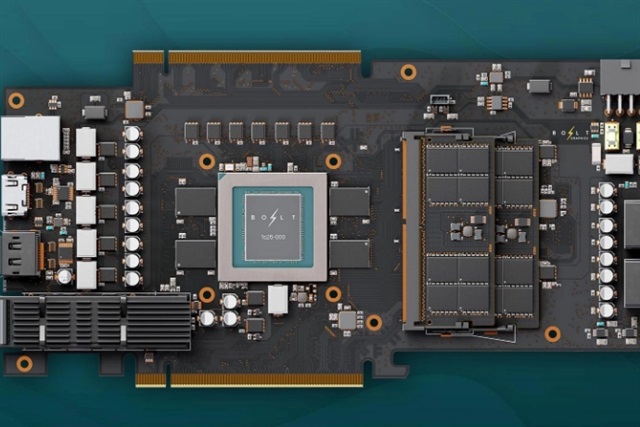
One hundred million dollars to fund a GPU that does not intend to limit itself to artificial intelligence. That is the ask Bolt Graphics has put on the table to support the development of Zeus, a card designed to challenge Nvidia and AMD on a broader terrain than LLM accelerators alone. The news, stripped down, includes no technical specifications: no data on VRAM, memory, power draw or compute capacity. Yet the mere fact that a third actor in the GPU market is seeking Series A-scale capital is already a structural signal.
The ecosystem is the real rival
Bolt Graphics' real rival is not a single chip. It is the ecosystem Nvidia has built around CUDA and the libraries that handle training, inference, quantization and fine-tuning. Companies running on-prem or hybrid setups do not choose a GPU only by teraflops: they choose compatibility with existing pipelines, predictable drivers, mature frameworks and total cost of ownership. A new accelerator can offer competitive specs, but if it forces teams to rewrite connectors or maintain parallel stacks, the silicon savings disappear into operational costs.
For organizations running self-hosted LLMs, a third supplier can shift negotiating power. The implicit toll for hardware acceleration is currently dominated by two names, and tight supply has already pushed many firms to plan purchases months in advance. If Zeus reached production with a credible ecosystem, the first beneficiaries would be private data centers and teams that need data sovereignty without relying on hyperscale clouds. For large providers, the effect would be ambivalent: more upstream competition could lower accelerated instance costs, but also erode the vertical optimization that currently supports high margins.
The 'beyond AI' label suggests a broader positioning, perhaps toward simulation, professional graphics or scientific computing. In these areas the validation cycle is long and the installed base of specialized software is even more conservative. A new GPU is not enough: it takes a full stack of drivers, profilers and vendor support to convince an HPC team to migrate.
The source provides no numbers. That omission is not neutral: in a market where memory and bandwidth determine the ability to serve models with extended contexts, announcing a round without technical details suggests the game is played more on investor confidence than on public product demonstration. It is a legitimate strategy, but it also explains why the bar for a new entrant is so high.
For those evaluating on-premise deployments, there are trade-offs between ecosystem maturity and lock-in cost; AI-RADAR offers analytical frameworks at /llm-onpremise to help navigate the decision without reducing it to a single variable. The question is not whether Bolt Graphics will raise the $100 million, but whether it can build around Zeus the same belt of software and trust needed to turn a promising GPU into a real deployment choice.





💬 Comments (0)
🔒 Log in or register to comment on articles.
No comments yet. Be the first to comment!