The Evolution of AI Servers: New Sockets from AMD and Intel at Computex
The artificial intelligence landscape, particularly that of Large Language Models (LLM), continues to push the boundaries of hardware innovation. At Computex, one of the most significant events for the tech industry, AMD and Intel presented their answers to this growing demand, unveiling new sockets for future generations of server processors. These platforms are not mere updates but represent a fundamental step for the architecture of next-generation AI servers, with direct implications for companies aiming for on-premise deployments.
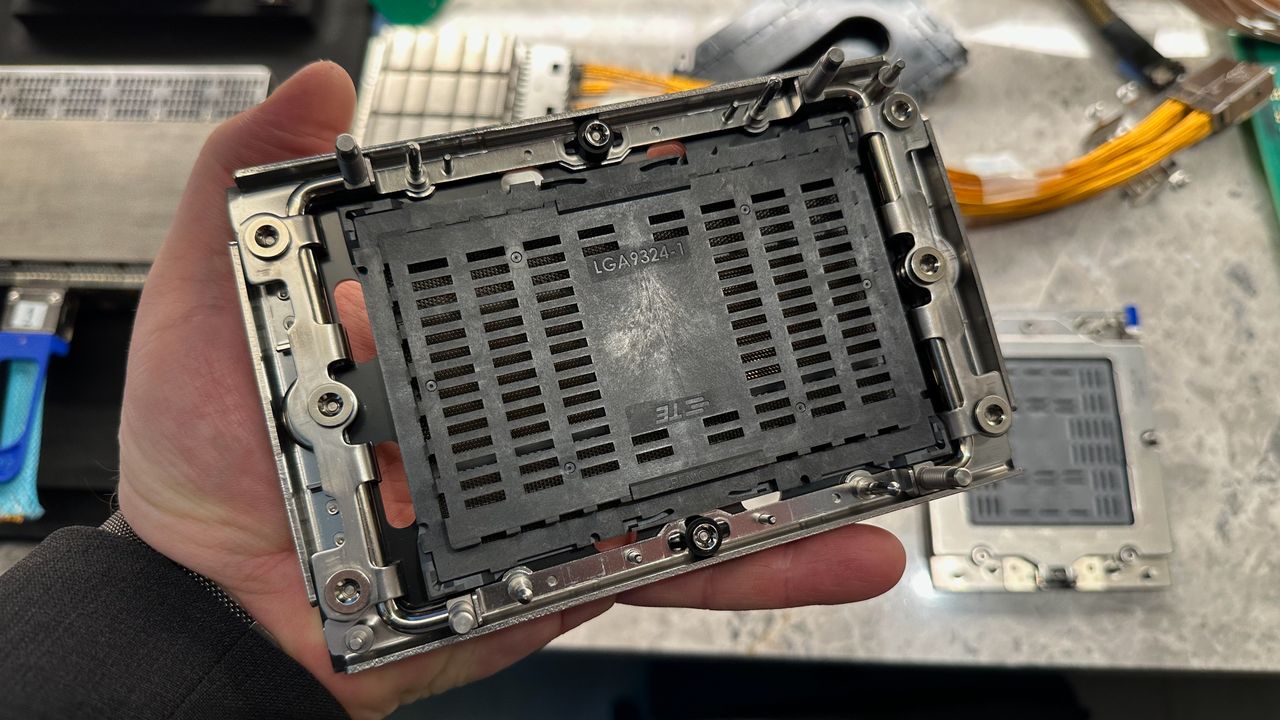
AMD introduced its SP7 socket, designed to host EPYC processors codenamed "Venice." In parallel, Intel showcased its impressive LGA9324-1 socket, featuring a substantial 9,324 pins, intended for "Diamond Rapids" processors. The appearance of these sockets at Computex signals the imminent availability of new CPUs that promise to redefine the capabilities of dedicated AI servers, providing the computational foundation necessary to handle increasingly complex workloads.
Technical Details and Architectural Implications
The size and complexity of these new sockets are not coincidental. A high pin count, such as the 9,324 pins of Intel's LGA9324-1, is indicative of an architecture designed to support a significant increase in cores, memory channels, and PCIe lanes. These elements are crucial for AI servers, where the ability to move large amounts of data between the CPU, memory, and accelerators (like GPUs) is as important as raw computing power. Processors with more cores and higher memory bandwidth can more efficiently handle the massive datasets and complex models typical of LLM training and Inference.
Innovation at the socket and CPU level is fundamental for optimizing throughput and reducing latency in AI workloads. These new designs improve the interconnection between various system components, ensuring that GPUs are not "starved" for data and can operate at maximum efficiency. For companies developing and deploying AI solutions, the choice of CPU platform is a determining factor for overall performance and the scalability of their infrastructures.
The Context of On-Premise Deployments and Data Sovereignty
The introduction of such advanced sockets for AI servers has a significant impact on organizations that prioritize on-premise or hybrid deployments. The ability to have the latest generation CPUs directly in their data centers offers unprecedented control over hardware and the execution environment. This is particularly relevant for sectors with stringent data sovereignty requirements, regulatory compliance, or for air-gapped environments, where cloud services are not a viable option.
Evaluating the Total Cost of Ownership (TCO) of an on-premise AI infrastructure requires a thorough analysis that includes initial hardware costs, power, cooling, and maintenance. AMD's and Intel's new CPUs, while representing an initial investment, can offer long-term benefits in terms of efficiency and performance for specific AI workloads. For those evaluating on-premise deployments, AI-RADAR offers analytical frameworks on /llm-onpremise to assess the trade-offs between control, performance, and operational costs compared to cloud-based solutions. Choosing a robust and high-performing CPU architecture is a cornerstone for building a resilient and scalable AI infrastructure.
Future Prospects for AI Infrastructure
The announcement of the SP7 and LGA9324-1 sockets at Computex highlights a clear market direction: server hardware is constantly evolving to meet the increasingly intense demands of artificial intelligence. While GPUs remain the workhorses for parallel computing, new-generation CPUs play an irreplaceable role in data management, workload orchestration, and executing portions of models that benefit from high single-thread speed or rapid memory access.
This platform-level innovation is essential to enable the next wave of AI applications, from more complex multimodal models to generative AI systems requiring real-time responses. Companies investing in these new hardware technologies will be better positioned to fully leverage the potential of AI, while maintaining control over their data and operations—an increasingly critical factor in the current technological landscape.








💬 Comments (0)
🔒 Log in or register to comment on articles.
No comments yet. Be the first to comment!