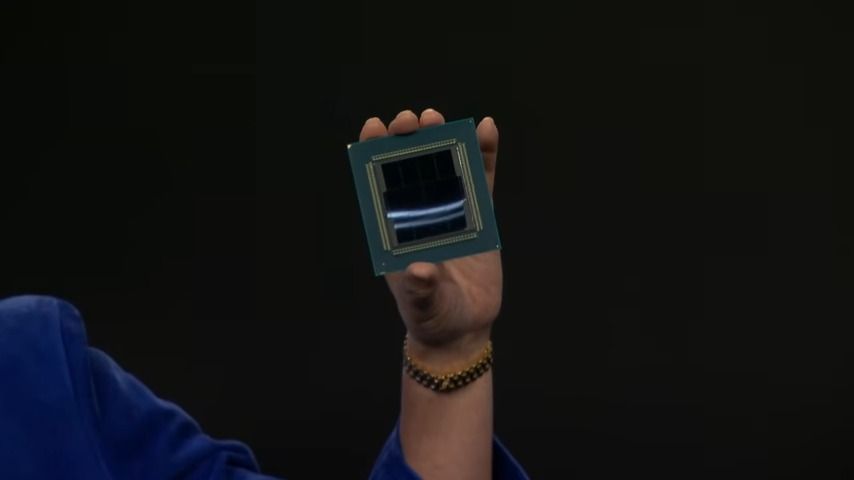
AMD EPYC Venice: Production Ramp Begins for 2nm 256-Core HPC Chip
AMD has announced the commencement of mass production for its EPYC Venice processor, a significant innovation in the High-Performance Computing (HPC) chip landscape. This new processor stands out with its 256-core architecture and as the first HPC chip manufactured using a 2-nanometer process, promising a 70% performance leap compared to previous generations. The introduction of Venice to the market marks a crucial moment for data center infrastructures, especially those geared towards intensive workloads such as artificial intelligence and large-scale data analytics.
AMD's commitment to the EPYC processor segment is well-known, with a strategy focused on offering high-performance and energy-efficient solutions for the enterprise sector. The arrival of Venice further strengthens this position, providing system architects and IT managers with a powerful tool to address growing computational demands, particularly for on-premise deployments that require control and data sovereignty.
Technical Details and Performance Implications
The most striking feature of the EPYC Venice is its impressive 256-core count. Such core density is designed to maximize parallelism, a critical factor for HPC applications ranging from scientific modeling to complex simulations. In the context of artificial intelligence, a high number of CPU cores can be particularly advantageous for workload orchestration, data pre-processing, and for the inference of smaller LLMs or those with high levels of quantization, where latency is a key factor.
The adoption of the 2-nanometer manufacturing process represents a notable technological achievement. This miniaturization not only allows for the integration of a greater number of transistors and cores in a reduced space but also significantly improves energy efficiency. For data centers, this translates into reduced power consumption and heat dissipation, contributing to optimizing the Total Cost of Ownership (TCO) and reducing the environmental footprint of infrastructures. The claim of a 70% performance increase suggests that Venice could redefine standards for executing intensive workloads, allowing for the consolidation of more tasks on less hardware.
The On-Premise Context and Data Sovereignty
For companies evaluating on-premise deployments for their AI workloads, the EPYC Venice offers a compelling value proposition. Server hardware based on these processors can provide the computational power necessary to keep data and models within corporate boundaries, ensuring greater control over security, compliance, and data sovereignty. This is particularly relevant for regulated industries or organizations with stringent privacy requirements, where adopting cloud solutions can present significant challenges.
Investing in self-hosted infrastructures with chips like Venice allows for long-term TCO optimization, balancing initial CapEx with more direct control over operational costs and resource utilization. While GPUs remain the predominant choice for intensive Large Language Model training, the latest generation EPYC processors can play a fundamental role in hybrid architectures, managing pre-processing, post-processing tasks, or the inference of less demanding models, freeing up GPU resources for heavier workloads. For those evaluating on-premise deployments, analytical frameworks are available at /llm-onpremise that can help assess the trade-offs between different architectures and hardware solutions.
Future Prospects for AI Infrastructure
The start of production for the AMD EPYC Venice is not just news for the HPC sector but an indicator of the direction AI infrastructure is taking. With the growing demand for computational capacity for artificial intelligence, the availability of high-performance, high-efficiency chips like Venice is crucial to supporting the evolution of models and applications. This processor could enable new possibilities for executing complex AI workloads directly in enterprise data centers, reducing reliance on external cloud services and offering greater flexibility.
Competition in the server and AI processor market continues to intensify, driving innovation on all fronts, from core count to manufacturing process miniaturization. The EPYC Venice positions itself as a key player in this scenario, providing a solid foundation for future generations of on-premise AI infrastructures, where performance, efficiency, and control are priorities.



💬 Comments (0)
🔒 Log in or register to comment on articles.
No comments yet. Be the first to comment!