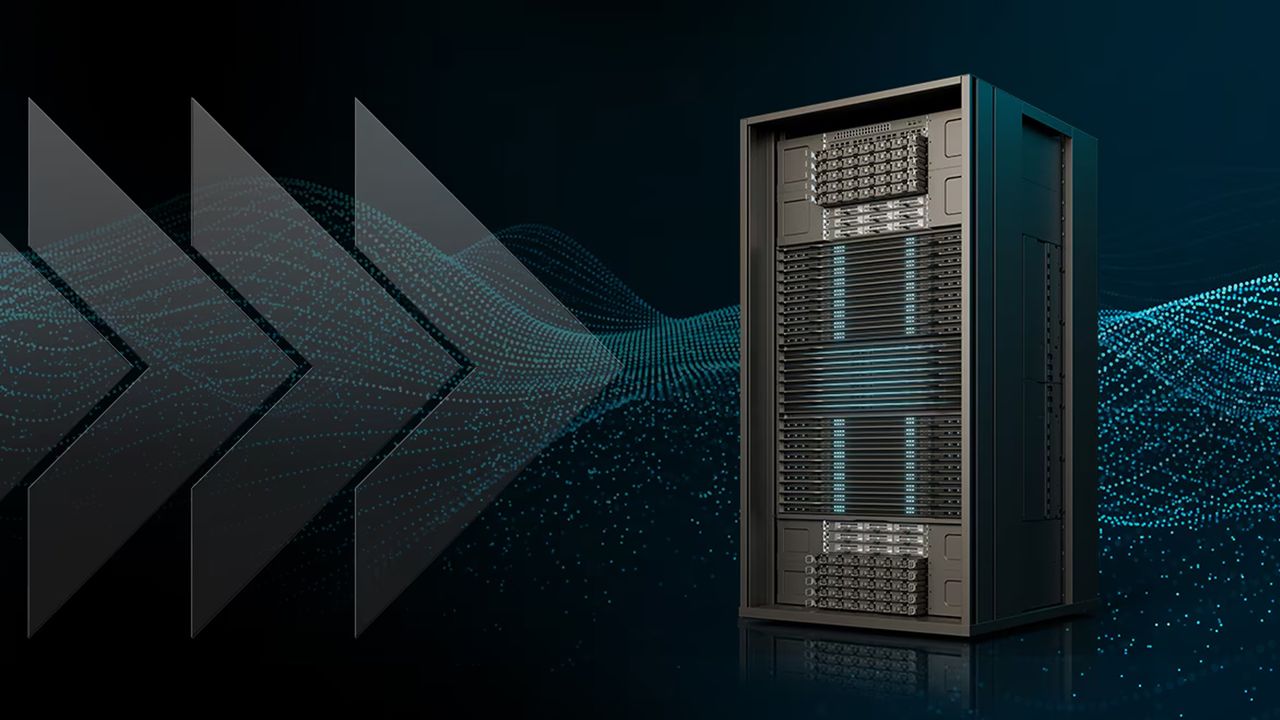
AMD Helios MI455X: A New Player in the On-Premise AI Landscape
AMD has lifted the veil on its Helios MI455X platform, a complete rack system designed to address the growing demands of artificial intelligence workloads. This new offering positions itself as a direct competitor to current leading solutions, providing infrastructure architects and CTOs with an additional option for their AI deployments. The introduction of Helios MI455X underscores AMD's commitment to delivering robust hardware for AI acceleration, a rapidly expanding market segment.
The Helios MI455X platform, presented as a rack system, is intended for environments that require direct control over hardware and data. This makes it particularly appealing to organizations prioritizing data sovereignty and on-premise deployments, including air-gapped scenarios. The availability of new hardware architectures is crucial for fostering innovation and offering greater flexibility in designing scalable and high-performance AI infrastructures.
UALink-over-Ethernet Interconnect: Advantages and Trade-offs
A distinctive feature of the Helios MI455X platform is its adoption of UALink-over-Ethernet interconnects. In multi-GPU AI systems, the speed and efficiency of interconnections between processing units are critical parameters that directly influence the overall system's throughput and latency. Proprietary high-bandwidth solutions are often employed to ensure ultra-fast communication between GPUs, which is essential for training Large Language Models (LLM) and for large-scale inference.
AMD's choice of UALink-over-Ethernet suggests an approach that might balance performance with the familiarity and cost-effectiveness of existing Ethernet infrastructure. However, the source indicates that the potential downsides of Ethernet could limit performance in particularly intensive scenarios. For AI workloads requiring tight synchronization and massive data transfer between GPUs, Ethernet's latency and bandwidth might not match those of specialized interconnects, negatively impacting training time or inference throughput.
Implications for On-Premise Deployments and TCO
For decision-makers evaluating the adoption of self-hosted AI platforms, the choice of interconnect has a significant impact on the Total Cost of Ownership (TCO) and future scalability. Utilizing Ethernet could reduce initial costs and integration complexity into existing networks, leveraging existing expertise and infrastructure. This is a relevant factor for companies looking to optimize the CapEx and OpEx of their data centers.
On the other hand, if performance limitations due to the interconnect were to manifest, they might necessitate a greater number of nodes to achieve the same throughput level, effectively increasing long-term TCO. Evaluating platforms like Helios MI455X requires a thorough analysis of specific AI application requirements, balancing the benefits of a more standardized network infrastructure with the extreme performance demands typical of LLM training and inference workloads.
Future Prospects and Strategic Evaluation
The introduction of the AMD Helios MI455X platform enriches the landscape of available AI hardware solutions, offering new opportunities for companies seeking alternatives to dominant vendors. Competition in this sector is a positive factor, driving innovation and diversification of offerings. However, choosing an AI platform is never trivial and requires a clear understanding of the trade-offs involved.
For CTOs and infrastructure architects, it is crucial to carefully assess how the interconnect architecture influences the ability to scale workloads, manage latency, and optimize TCO in an on-premise context. AI-RADAR provides analytical frameworks on /llm-onpremise to support these strategic decisions, helping to compare different hardware and architectural options based on specific performance, cost, and data sovereignty constraints.







💬 Comments (0)
🔒 Log in or register to comment on articles.
No comments yet. Be the first to comment!