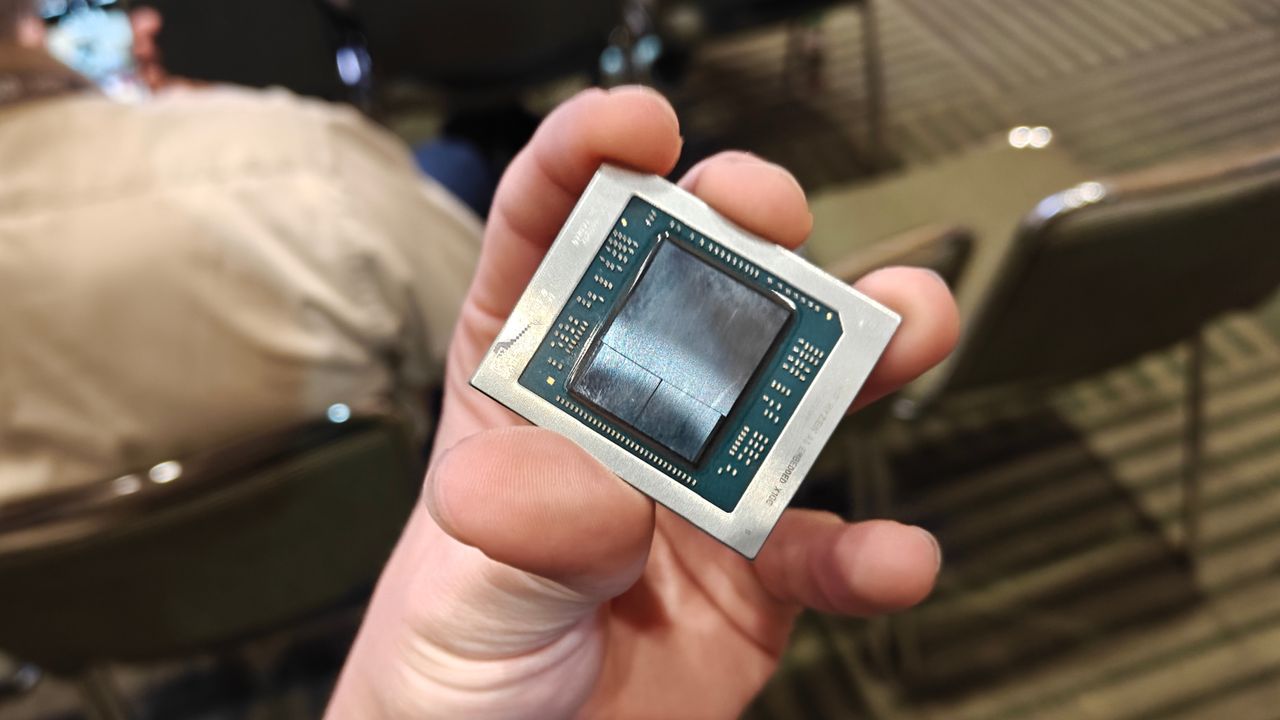
AMD's move with the new X100 chips is not a simple product refresh; it's a strategic positioning into a territory where artificial intelligence ceases to be a cloud service and becomes a physical, distributed, local activity. Putting the Strix Halo APU – with Zen 5 CPU cores and RDNA 3.5 GPU cores – directly into robots means bringing the same architecture designed for high-performance laptops inside machines that must decide in real time, without a network, often in harsh environmental conditions.
The most disruptive aspect of the announcement is the choice of an APU over the classic discrete CPU + GPU combination. In a commercial or logistics robot, space, weight, and power consumption are fierce design constraints. A single package merging the flexibility of x86 cores with a graphics engine capable of accelerating neural networks reduces on-board complexity and shifts the computing center of gravity from the server rack to the extreme edge. This is not a technical detail: it is a structural signal that physical AI – the ability to perceive, reason, and act in physical space – will increasingly live on integrated silicon and less on pipelines that bounce data between a sensor and a distant data center.
AMD chooses to compete head-on with Intel and its upcoming Panther Lake, which is also built around tight integration of AI accelerators. But the move to place the APU in robotics early signals a different bet: it's not a race on raw teraflops, but on architectural coherence for mixed workloads – visual inference, motion planning, SLAM – that cannot tolerate latency. Those developing robotic fleets for warehouses or manufacturing gain the ability to run machine learning models entirely on-premise, without depending on a cloud connection. This translates into a concrete advantage for data sovereignty: video streams and commands physically remain inside the plant, a factor that compliance officers are beginning to weigh with the same attention as energy consumption.
On-premise deployment, for those who produce and maintain autonomous robots, is no longer an ideological choice but an operational necessity. The latency of a round-trip to the cloud for a navigation decision can compromise safety; constant telemetry to remote servers creates privacy risks and bandwidth costs. With an APU like Strix Halo, the entire stack – real-time operating system, perception layers, decision engines – compacts onto a single chip, reducing TCO and simplifying maintenance. It is the flip side of the 'intelligent thin client' model: intelligence stays where it's needed, while the cloud limits itself to high-level orchestration.
On the competitive front, Intel will not stand still, but AMD brings a time advantage and an important card: the RDNA 3.5 architecture is already mature for visual inference workloads, with pipelines optimized for tensor cores and quantization. This places the X100 proposition in a segment that can also erode the dominance of NVIDIA Jetson, especially where per-unit cost and integration simplicity matter more than brute floating-point power. For system integrators, the ability to write for a single x86 platform without compromises on the GPU side accelerates prototyping cycles and reduces dependency on specialized SDKs.
The arrival of Strix Halo in robots marks a point of no return for AI infrastructure: it is no longer just a data center problem, but a machine-level one. Anyone designing inference workloads for autonomous fleets will have to think in terms of extreme on-premise deployment, where latency is measured not in milliseconds but in centimeters of braking distance, and data sovereignty is not an accessory requirement but part of the supply contract.





💬 Comments (0)
🔒 Log in or register to comment on articles.
No comments yet. Be the first to comment!