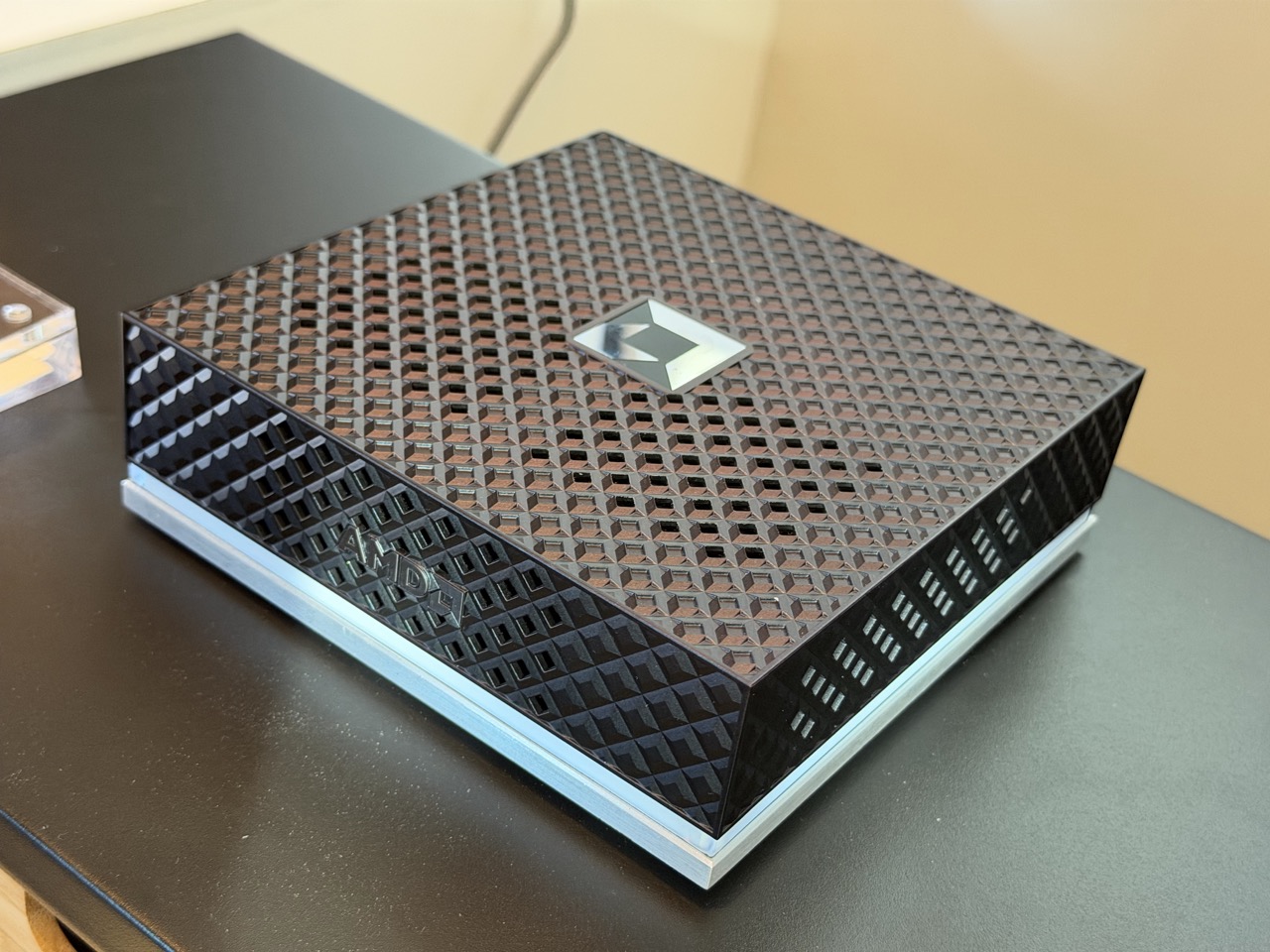
AMD Ryzen AI Halo: A New Tool for On-Premise AI Development
During Computex 2026, AMD captured attention by showcasing its AI developer PC, named Ryzen AI Halo. The device was featured in a live demo, providing an opportunity for the company to highlight the capabilities of its dedicated hardware platform for artificial intelligence. This move underscores the increasing importance of local solutions for the development and deployment of Large Language Models (LLM) and other AI applications.
The availability of a PC specifically labeled as an “AI Developer PC” reflects a clear trend in the industry: the need for powerful and accessible tools that enable teams to develop, test, and optimize AI models directly on-premises. This approach is particularly relevant for organizations prioritizing data sovereignty and control over the entire development pipeline.
Technical Details and Implications for Developers
While specific technical details of the Ryzen AI Halo were not fully disclosed during the event, its designation as an AI developer PC suggests a hardware configuration optimized for intensive workloads. Typically, such systems integrate processors with dedicated Neural Processing Units (NPUs) and GPUs with sufficient VRAM to handle medium-sized language models or for fine-tuning larger LLMs. The ability to perform inference and training locally is crucial for developers who need to iterate rapidly, maintain data sovereignty, and control the entire software stack, from the framework to the models.
For infrastructure architects and DevOps leads, a developer PC of this type represents a fundamental entry point for experimentation and prototyping. It allows for evaluating the performance of different models and quantization strategies in a controlled environment before scaling up to larger infrastructures, such as bare metal server clusters or hybrid solutions. The ability to work with sensitive data without having to move it to external cloud platforms is a significant advantage in terms of security and compliance.
The Context of On-Premise Deployment and Data Sovereignty
The introduction of hardware like the Ryzen AI Halo perfectly aligns with AI-RADAR's focus on on-premise and hybrid deployments. For CTOs and decision-makers, the opportunity to develop and test AI solutions in a self-hosted environment offers tangible benefits in terms of security, compliance (especially for regulated sectors like finance or healthcare), and a more predictable TCO (Total Cost of Ownership) compared to the variable and often increasing costs of the cloud. These systems allow sensitive data to remain within the corporate perimeter, a fundamental requirement for companies operating in air-gapped contexts or with strict privacy policies.
The choice between on-premise and cloud development is not trivial and involves a series of trade-offs. While the cloud offers scalability and managed services, local solutions provide granular control over hardware, software, and data. The Ryzen AI Halo positions itself as an enabler for those seeking to maximize this control, providing a robust platform for AI innovation without compromising security and privacy requirements.
Future Prospects and Trade-offs in the AI Landscape
The availability of dedicated hardware for local AI development is a crucial enabling factor for innovation. It allows teams to explore new model architectures, optimize inference pipelines, and experiment with different quantization strategies without relying exclusively on external cloud resources. While developer PCs cannot replace large-scale training infrastructure, they represent a fundamental link in the AI value chain, offering a balance between performance, control, and cost for the initial and intermediate stages of development.
AI-RADAR continues to monitor these evolutions, providing analyses on the trade-offs between on-premise and cloud solutions to help decision-makers navigate this complex landscape. The emergence of devices like AMD's Ryzen AI Halo reinforces the idea that the future of AI will be increasingly hybrid, with a strong emphasis on the ability to manage critical workloads in controlled and secure environments.





💬 Comments (0)
🔒 Log in or register to comment on articles.
No comments yet. Be the first to comment!