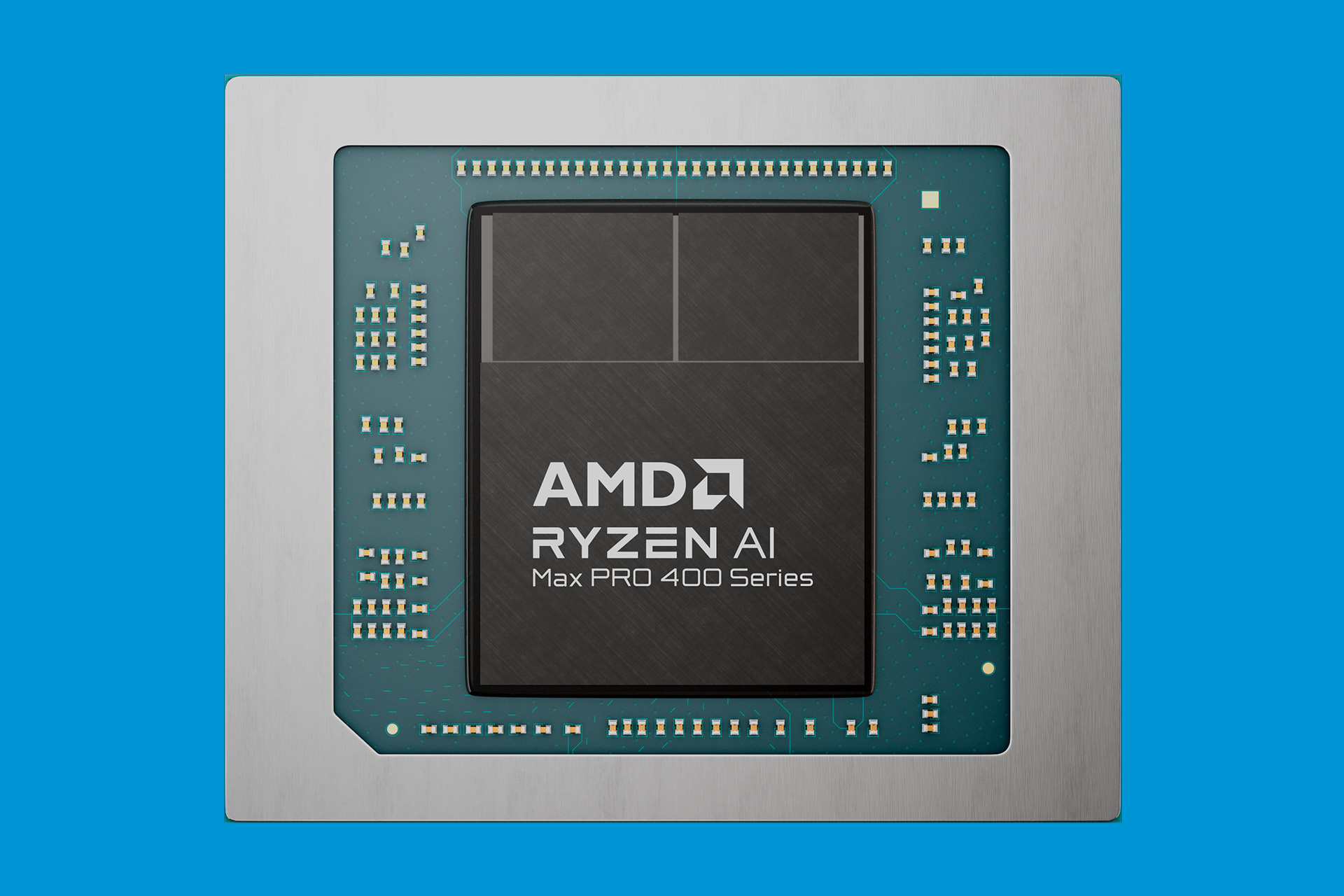
AMD Boosts Offering for Local AI Systems
AMD has announced the expansion of its Ryzen AI Max portfolio with the introduction of a new series of chips, the Ryzen AI Max PRO 400. This strategic move aims to strengthen the company's position in the growing artificial intelligence market, particularly for solutions requiring significant processing capabilities directly on-site. The focus is on enabling the execution of complex AI workloads without relying exclusively on external cloud infrastructures.
The availability of dedicated and high-performance hardware for on-premise AI is an increasingly critical factor for businesses. With the rising complexity of Large Language Models (LLMs) and the need to process large volumes of sensitive data, the ability to maintain control over the entire AI pipeline becomes a fundamental competitive advantage. AMD's new chips fit precisely into this context, offering a robust hardware foundation for such scenarios.
Extended Memory Capacity for Large LLMs
The distinctive strength of the Ryzen AI Max PRO 400 series lies in its support for up to 192GB of memory. This capacity is particularly relevant for AI systems, as it allows for managing significantly larger LLMs than previously possible on local platforms. The amount of available memory directly constrains the size of models that can be loaded and executed for Inference, also influencing the context window length and the complexity of operations.
Running large LLMs requires substantial memory resources to host model parameters and intermediate data during processing. With 192GB, developers and system architects can explore using models with billions of parameters, or larger versions of existing models, which would otherwise be confined to cloud deployments or high-end, costly GPU systems. This opens new possibilities for optimizing and Fine-tuning models specific to enterprise needs.
Implications for On-Premise Deployment and Data Sovereignty
The introduction of chips with such memory capabilities has profound implications for on-premise deployment strategies. Organizations operating in regulated sectors, or handling highly sensitive data, can now consider implementing advanced AI solutions directly within their own data centers or even at the edge. This approach ensures greater data sovereignty, reducing the risks associated with transferring and processing information on third-party platforms.
Furthermore, local deployment can contribute to optimizing the Total Cost of Ownership (TCO) in the long run, balancing the initial hardware investment with reduced operational costs resulting from less reliance on consumption-based cloud services. The ability to run larger LLMs locally also means lower latency and potentially higher Throughput for critical applications, fundamental aspects for scenarios like industrial automation or real-time financial analysis. For those evaluating the trade-offs between cloud and on-premise, AI-RADAR offers analytical frameworks on /llm-onpremise to support informed decisions.
Future Prospects in the Local AI Landscape
AMD's move underscores a broader trend in the tech industry: the growing demand for decentralized AI capabilities. While cloud computing continues to be a viable solution for many scenarios, the need for control, privacy, and specific performance is driving a wider adoption of self-hosted and air-gapped solutions. The Ryzen AI Max PRO 400 chips represent a significant step in this direction, offering system architects new tools to build resilient and compliant AI infrastructures.
The market for LLM Inference hardware is rapidly evolving, with various players proposing innovative solutions. AMD's 400 series positions itself as an interesting option for companies looking to balance performance, costs, and security requirements. Competition in this segment will further stimulate the development of increasingly efficient and accessible technologies, benefiting a wide range of AI applications that extend beyond the traditional data center boundaries.





💬 Comments (0)
🔒 Log in or register to comment on articles.
No comments yet. Be the first to comment!